
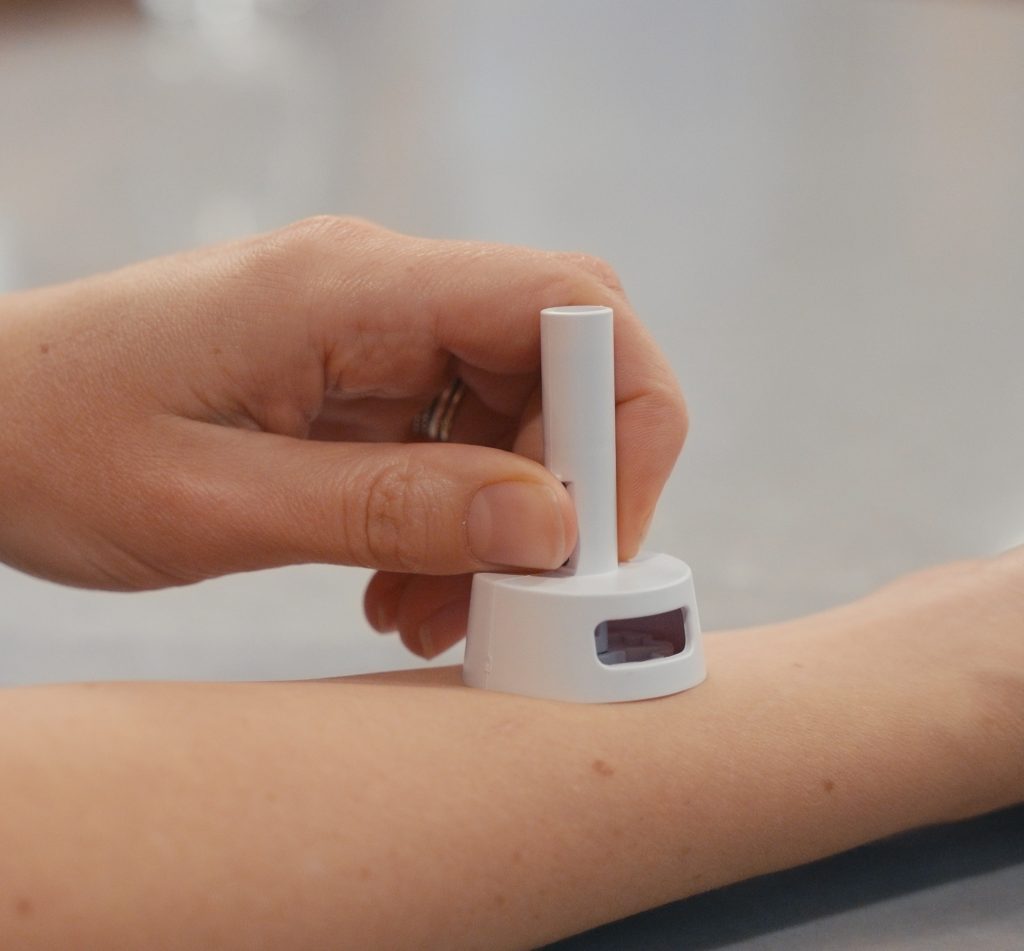
A microneedle stamp applied for just minutes a day is being tested as a new way to desensitize adults and children with peanut allergy.
Atlanta-based biotech company Moonlight Therapeutics has launched the first clinical trial of its intradermal immunotherapy stamp, MOON101. The stamp is covered in tiny needles coated with minute amounts of peanut protein.
When applied to the skin, the microneedles insert the allergen just deep enough to reach specialized immune cells known as Langerhans and dermal dendritic cells, says Samir Patel, PhD, Moonlight’s CEO and co-founder. Over time, exposing these cells to an allergen may help build immune tolerance.
“If you can deliver the allergens to the part of the skin where the most relevant immune cells are, then you can desensitize someone through the skin rather than the oral or gastrointestinal tract,” says Patel, a chemical and biomolecular engineer.
Skin acts as a barrier that keeps large proteins like peanut out, Patel says. The idea behind the stamp is, “if you can create very tiny holes to allow the protein to get in, then the protein could more efficiently interact with the immune cells that you’re trying to target.”
As a result, “you could do it quickly. You don’t have to wear the patch all the time.”
Safety Study of Microneedle Stamp
Moonlight’s Phase 1 SURVEYOR trial will enroll 40 participants. It will begin with peanut-allergic adults, followed by teens and then children ages 4 to 11.
The peanut stamp will be applied to one arm for three minutes. A placebo stamp without allergen will be applied to the other. The placebo will help researchers to determine whether any skin reactions are caused by the peanut or the stamp itself.
Participants will receive five doses, escalating from 1 to 100 micrograms, over five weeks. “The dosages we’re talking about are extremely tiny,” Patel says. By comparison, oral immunotherapy (OIT) typically starts at about 1 milligram. That’s 1,000 times larger than a microgram. In OIT, patients consume gradually increasing amounts of their allergen to build tolerance.
The Phase 1 trial’s primary goal is to evaluate safety and tolerability. This will include the highest dose participants can handle without significant reactions. The study is led by Dr. Brian Vickery, chief of Allergy and Immunology at Children’s Healthcare of Atlanta and head of the Allergy and Immunology division at Emory University. It will be conducted at centers in Arkansas, Georgia, Kansas, Michigan and North Carolina. (If interested in enrolling, see specifics here.)
Researchers will also measure changes to IgE antibodies, which trigger allergic reactions, and IgG antibodies, which protect against reactions. However, given that patients will only receive a few doses, it’s not meant to measure desensitization at this stage.
That would come later. If the results from the safety study, which are expected by the end of 2027, look good, a Phase 2 trial evaluating efficacy could begin in 2028, Patel says.
The Phase 2 trial has not been designed yet. But Patel says it will likely consist of six months of daily doses, mostly done at home.
Mice Rapidly Desensitized
The dermal stamp has shown promise in early research. A 2022 study in mice found the intradermal stamp desensitizes more quickly and effectively than a patch that sits on top of the skin.
In that study, one group of mice had the dermal stamp applied once a week for five minutes. A second group wore a peanut patch, also known as epicutaneous immunotherapy, or EPIT, 24 hours a day.
After five weeks, 90 percent of the mice treated with the microneedles were desensitized and didn’t react after consuming peanut. It took eight to 12 weeks for mice wearing the EPIT patch continuously to achieve significant desensitization.
“We compared a minimally invasive, five-minute microneedle device versus a 24-hour skin patch, and found the microneedle device to be far superior,” Dr. Jessica O’Konek, PhD, senior author and research assistant professor at the Mary H. Weiser Food Allergy Center at the University of Michigan, said at the time.
The 2022 mouse study didn’t use the actual Viaskin Peanut patch by DBV Technologies, which is for children ages 1 to 7. A Phase 3 Viaskin trial found about 47 percent of children were “responders” after one year on the DBV patch.
That meant that if children reacted to 30 mg of peanut at the start of the trial, they could tolerate 10 times that, or at least 300 mg after one year of patch wearing. If they started at a higher baseline of 100 mg, after a year they could consume at least 600 mg of peanut. (A peanut kernel is about 250 to 300 mg.)
DBV plans to submit for FDA approval of their patch in kids ages 4 to 7. A submission for toddlers ages 1 to 3 will follow. Their toddler study found that, after three years, 71 percent of toddlers using the patch could tolerate three or four peanuts.
Targeting Peanut-Allergic Adults

Moonlight’s research is supported by the National Institute of Allergy and Infectious Diseases (NIAID). It awarded the company $6.3 million in grants for the clinical trial and to continue developing the device as a multi-food allergen treatment. FDA approval will require separate approvals for the device and the allergen extract, Patel says.
Moonlight also received a $3.3 million grant from the Defense Health Agency (DHA) Congressionally Directed Medical Research Programs to develop a food allergy treatment for adults.
Moonlight’s research qualified because the DHA determined food allergies affect military readiness and can disqualify potential recruits from military service.
Microneedles as potential drug delivery devices were first developed several decades ago. They have shown promise in research, particularly as vaccine delivery devices. But currently there are no FDA-approved medical treatments that use microneedle-based drugs or biologics.
According to a review of microneedle research, delivering consistent doses through the skin can be challenging because skin thickness can vary from person to person, and across different spots on the body. Application force and needle length can also affect how much drug gets through.
Goal with Stamp: Multiple Allergens
How many microneedles need to be coated in allergen to desensitize, and at what concentration, are among the questions Moonlight’s clinical trials will seek to answer, Patel says.
The eventual goal is to use the stamp approach to desensitize to multiple foods at the same time. “One of the grants we’ve gotten from the NIH is to demonstrate we can do multiple allergens on one stamp,” he says.
Each of the stamp’s 500 stainless steel microneedles are about half a millimeter long. That’s less than half the width of a U.S. quarter. Robotic technology precisely places the allergen extract on each individual microneedle, Patel says.
“Think of it like a pizza pie with slices. You could put three slices with peanut, three slices with walnut, and two slices with milk, or some other combination,” he says.
But first, researchers need to determine the optimal dose, and what size stamp they’d need to fit multiple allergens. “We have a pretty good idea around peanut, but we don’t know about the other allergens,” Patel says. “We’ll learn a lot from this initial clinical study.”
Applying the stamp should be painless, he says. The needles penetrate only the outermost layers of the skin, rather than into the deeper dermis. That’s where the nerve endings and blood vessels are located.
Patel says the sensation is similar to Velcro being pushed against the skin. “I’ve applied it to myself, and it feels like a tingly sensation,” he says.
Related Reading:
5-Minute Microneedle Patch Desensitizes Peanut-Allergic Mice
DBV Touts Viaskin Patch Results, Soon Will Seek FDA Approval