
Yogurt from a cow – how could I, a dairy-allergic mom, give this to my own infant son? I posed the question to myself, considering both emotional and practical implications. My own contact with dairy had resulted in the use of an epinephrine auto-injector too many times to count, and yet ….
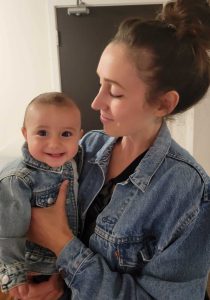
My son was six months old and had been eating solids for two months. It was high time I started introducing my allergens to him. I knew that current research shows early introduction of allergenic foods can prevent food allergies from developing in many young children. I was determined to try everything in my power to give him a shot at not developing food allergies like his mom.
The only thing stopping me was my own mental block. I realized that I’d come to view my allergens as poison, and could not fathom my own child eating them safely. For other people, sure, it was no issue. But because he carries my genes and my cells, I couldn’t escape feeling that my allergens would be dangerous for him, just as they are for me.
Secondly, how could I expose him to these foods in a way that was safe for me as an allergic parent? Babies are messy eaters by nature. They enjoy the tactile experience of handling their food, and are just starting to develop physical coordination. I couldn’t expect my child to scoop some yogurt with a spoon and neatly get it all in his mouth.
As I said in the first article of my Food Allergic and Having a Baby series, I felt in control when I was the one steering the ship. So I devised a plan and long-term schedule for early allergen introductions. It was my charge to lead.
Introducing Baby to Possible Allergens
As we now know, early introduction of the top food allergens can help a child’s immune system develop tolerance to those foods. Delaying introduction of a food could, in contrast, result in sensitization.
As I mentioned in the second series’ article, keeping an allergenic food in the diet regularly is also important. Food allergy dietitian Dr. Carina Venter pointed out that introducing a top allergenic food to baby once, followed by a long period without exposure, could also lead to sensitization.
I breastfed my son for six months, and started him on solids at four months when he showed signs of readiness. During this period, I introduced him to the top allergens that I safely eat, for example, eggs, fish and wheat. Those were easy enough to knock off the list.
I couldn’t find a conclusive answer as to whether his latching on to breastfeed after having eaten my allergens would cause me to react. To me, it felt like an unnecessary risk to take. So at six months I weaned him onto a dairy-free infant formula that was safe for me to handle and ingest. Fortunately, he loved it, and I had freed the nipple, so to speak.
To start introducing my own allergens, I preferred not to do it alone. I needed to delegate tasks to my village. My husband took over the dairy and soy introductions, creating his own set of rules. No toys in hand while eating mommy’s allergens. A full wash of face, hands and high chair tray after eating. Utensil and bowl directly into the dishwasher.
If our baby’s clothes were messy, they went straight into the washing machine. It was a bit of a chore, but totally worth the effort.
Early Food Introduction: Oddly Empowering
Despite my nervousness towards my son eating the things I’m allergic to, I found myself zealously pushing forward. I was perhaps more obsessed with early allergen introductions than I was with his gut microbiome.
I was also conscious of whether he would get exposed to top allergens via skin contact. The LEAP study and other research show that exposure to a top allergen through the skin may lead to sensitization if it hasn’t been introduced as a food.
As a lifelong label reader, I came across many non-food sources of allergens. Diapers containing soy protein isolate, rash cream containing almond oil, and bath wash containing dairy. I avoided skin exposure to these foods until they had become a regular part of my son’s diet. And I favored personal-care products that were allergy-safe for me to handle.
As a mom with food allergies, I felt empowered once we got the ball rolling on early food introductions. It was a positive and actionable step.
Introducing peanuts and nuts revealed that my mom had lingering emotions about my own first anaphylactic reactions as a young child. I respected that it was triggering for her to see her grandson eat things that her own child reacted to. Her skittishness when we gave him a bite of a meatball one day at a family dinner was telling. “Amanda ate a bite of a meatball as a baby and was immediately covered in hives,” she recalled.
Baby’s Feeding Schedule Gets Complex

I decided we would do his peanut and almond introductions in the food court of Toronto’s Sick Kids Hospital. It was adjacent to a medical setting, which put my parents at ease, without medicalizing mealtime for my son. It felt like a healthy buffer for all. They came prepared with watered-down peanut butter, and I brought my 9-month-old, and plenty of wipes. We repeated the food court ritual a few times. Once we had proven he could safely eat peanuts and almonds, I ended our food court feeding sessions.
But what if he did have a reaction? I reassured myself with positive affirmations.
• I know what to do in the event of an emergency.
• I am capable of handling a reaction situation.
• I and our family are already skilled at managing food allergies.
• If he does have an allergy, he can still live a fulfilling life.
I determined his “mommy’s allergen” feeding schedule, which I logged into my Google Calendar. I set notifications and mapped out which foods he would eat and when. The aim was to ensure he was eating them a minimum of two times per week.
I made a list of all the foods we needed to introduce, and crossed them off with each successful introduction. If I felt unsure – maybe he was scratching his mouth or had a hive, I would revisit the food another day. Looking at the marked up list reminds me of our many victories.
Not ‘Going Nuts’ with Introducing Allergens
Once we had introduced our baby to most tree nuts, I found that even my Google Calendar couldn’t keep his exposure schedule organized. In order to not “go nuts” myself, I turned to an expert for guidance.
University of Colorado dietitian Carina Venter has a great workaround. She says a simple way to keep multiple nuts in an infant’s diet is to make a paste of mixed nuts. Then give the child a spoon of that a few times a week. They don’t need a large quantity of each nut, just continued regular exposure.
I implemented this strategy immediately. We served the paste in different forms. For example, watered down, blended into a smoothie (my son has his own dedicated blender bucket in our house), or spread on a cracker. Offering it in these forms made it easy to eat, and reduced the choking risk, since nut butters can be difficult for infants to swallow.
As my son grew from infant to toddler, things got easier. Visits to either of his grandparents’ houses were perfect opportunities to eat all the things mommy cannot. Feeding in our own home was less stressful as he got accustomed to the cleaning process. Once he started speaking, I could just tell him things.
We settled into a nice routine, and suddenly I did not need the online calendar anymore. He learned to use a straw and I was able to give him juice boxes of soy or almond milk without assistance. Because he learned about cross-contact prevention from such a young age, it has become second nature to him. As he has grown into a toddler and become more independent, it is also much easier to manage as an allergic mom.
Elated To See My Son Eat My Allergens
Something I never anticipated was the feeling of absolute elation that I get from seeing my child safely eat things I am allergic to. It’s indescribable.
His body loves the things I cannot have, and that makes me feel happy and relieved. A great source of joy for me now is for my husband or I to take him out for a special treat. Some macadamia nuts, a croissant, a Persian kabob.
While introducing allergens to our infant posed challenges for me as an allergic parent, I am proud of the three of us. We’ve navigated through it – and it wasn’t as scary as I thought it would be.
Actually, I came to appreciate the many skills my food allergies have afforded me. I’m a pro label reader, conscious of diet diversity and early introductions, skilled at cross-contact mitigation, and more.
And like all challenges that feel insurmountable, reaching the summit made us all feel a little bit stronger in the end.
The ‘Food Allergic & Having a Baby’ Series
• Women with Food Allergies: Why Many are Afraid to Get Pregnant
• Allergic and Giving Birth: My Hospital Food Plan Goes Awry
• Allergic Women: Why to Embrace the Messy Bits of Birthing
• Busting Myths on Food Allergy, Pregnancy and the Newborn
• This Article: How I Introduced My Baby to My Food Allergens
• Invasion of the Cheesy Crackers: an Allergic Mom on Playdates
Amanda Orlando is a cookbook author, food allergy advocate at EverydayAllergenFree, and founder of the non-profit organization Free To Be Me Society.