Did you let your husband see anything?
I’d be so embarrassed if mine saw anything.
Did the nurses wash her right away?
Did you wash your hands before touching her?
This is often a woman’s introduction to mother culture, or rather, the culture of having recently become a mom. It often involves questioning one’s cleanliness during labor and whether the woman should be embarrassed that her bare butt was fully exposed to the delivery room team.
And, God forbid, what about those fluids or fecal matter that escaped during the act of revealing her new baby?
Society in the last century quite literally washed away the beauty of the mother culture: the microbiome. In living foods, the “mother” is also the term for these foods’ starter culture. Kombucha and yogurt, for example, cannot grow without a mother that creates the microbial ecosystem of that food.
A human microbiome begins similarly. It is seeded to a baby by their mother through pregnancy, all the naturally nasty bits of arriving earthside, and shortly thereafter. Yet, many women feel pressure to have as clean a birth as possible in order to avoid shame and embarrassment. At some point, purposeful naturally occurring processes were rebranded as undignified.
In this article, I propose we shed the shame, embrace the beauty, and step out of the way of our naturally functioning ecosystems.
How does this relate to allergic disease conditions? In the past decade, researchers have begun to form a link between a baby’s gut microbiome and their likelihood of developing food allergies, asthma, or eczema. There is still a lot we don’t know, but it is clear that a child’s gut microbiome plays a strong role in the development of their immune system.
Allergic & Birthing: Bacterial Baptism
I’ll confess that I was a little nervous about giving birth to my son in a well-lit room with people I didn’t know. “Maybe we can leave the lights off the whole time,” I thought. But when the time came to push, I found myself feeling empowered and purpose-driven.
I shed my hospital gown and felt at peace with the whole team seeing the show. My son was arriving, and so be it if in that moment I was unkempt.

The “bacterial baptism” as it is called, occurs during birth as the baby passes through the birth canal and out into the world. As it does, science suggests the vaginal fluids the baby is covered in transfer beneficial bacteria from mom. A growing body of research indicates this helps to seed the infant’s gut microbiome.
Yet, this important birthing moment is the one many women consider embarrassing both to experience or converse about. No question, it is accompanied by sounds and smells that are, admittedly, less than appealing.
But why do we feel such disconnect and shame around a process that is so natural? The truth is, it is quite a powerful moment to deliver new life into the world.
As I lay on the bed to deliver the afterbirth on the day my son arrived, my face and hair coated in sweat, I shrieked: “Don’t wash off the vernix!” An alarmed group of nurses holding my wrinkly little son obliged.
Then I asked them to hold up my placenta so I could see what I had created before they disposed of it. The student doctor was amused, and they followed both of my requests with understanding.
Allergic & Birthing: the Microbiome
The vernix, that cakey white stuff that coats a newborn baby, is another nasty bit that is often hastily washed off due to the ick factor. But in recent years this has started to change as research has shown that vernix may serve a function to protect and develop a baby’s moisture barrier and outer layer of skin. This has been linked to decreasing the likelihood of developing atopic dermatitis, or eczema.
I spoke to Dr. Carina Venter, PhD, RD, at the University of Colorado, about how one can bolster their baby’s gut microbiome. For starters, she says many doctors now recommend leaving the vernix intact or just gently wiping the excess.
If a woman has a C-section rather than a vaginal birth, Venter says she need not be anxious about her child’s gut microbiome. She notes additional considerations for seeding a healthy gut microbiome:
- Practice skin-to-skin time with your newborn baby. Aside from providing comfort to your newborn as they feel the rhythmic beating of your heart, they also pick up good bacteria that live on your skin.
- Preserve as much colostrum as possible by either breastfeeding or pumping and bottle feeding it to your newborn. Colostrum is that thick, sticky, yellow breast milk that arrives just after your baby is born, which contains valuable bacteria and nutrients. It can also be collected on a clean baby spoon or a syringe, and administered to your newborn, if they miss some on the breast.
- Eating a diverse diet through pregnancy can also help to seed your baby’s gut in the womb.
Good Bacteria and the Diet
When it comes to what a pregnant woman eats, it’s helpful to know that natural food has a good bacterial load. So, when we eat a diverse diet, we are offering that nutrition to our child in utero. Fermented foods especially (dairy or non-dairy yogurt, sauerkraut, kimchi, for example) are known to be good for the gut.
The baby’s own gut is developing throughout their first year of life. Once they are ready to start solid foods, Venter suggests trying a good range of fresh foods and avoiding premade baby foods. She recommends striving for 100 foods in 100 days, with the understanding that this will not be executed perfectly.
This all relates back to the bacterial load in natural foods. Homemade purees do not have to be complicated, and there are lots of cookbooks or online recipes for making safe raw or cooked baby foods.
I found having a baby food machine to be very handy. I could hold my son in one arm and toss a handful of spinach and blueberries into the steamer basket with the other.
Birthing and Allergic Conditions
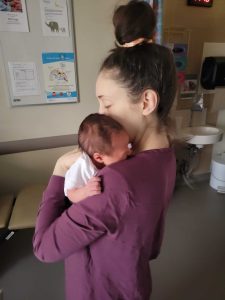
With this article in the Allergic Living series “Food Allergic and Having a Baby,” I’d like to make a suggestion. Let’s flip the culture of conversation toward new mothers away from the ick. Instead, let’s embrace and celebrate our body’s natural processes. There is nothing to be ashamed about.
While we do not know the exact relationship between our gut microbiome, our natural moisture barrier, and atopic conditions, we are starting to understand that a connection exists.
Living with food allergies can often feel like we are at the mercy of our body independent from our self. We allergic moms are waiting to grow out of it, hoping seasonal allergies aren’t so bad this year, wishing that eczema flare-up would go away. This can make us feel powerless.
But the gut microbiome feels like something we can influence, that we can educate ourselves about and act on. There is no a guarantee that prioritizing your baby’s bacterial ecosystem will necessarily stop food allergies from emerging. But it is certainly a start in a positive direction.
The ‘Food Allergic & Having a Baby’ Series
Women with Food Allergies: Why Many are Afraid to Get Pregnant
Allergic and Giving Birth: My Hospital Food Plan Goes Awry
Allergic Women: Here’s Why to Embrace the Messy Bits of Birthing
Debunking Myths About Food Allergies and Pregnancy
How I Introduced My Baby to My Food Allergens
Invasion of the Cheesy Crackers: an Allergic Mom on Playdates
Amanda Orlando is a cookbook author, food allergy advocate at EverydayAllergenFree, and founder of the non-profit organization Free To Be Me Society.