Aquestive Therapeutics has completed the additional research that the Food and Drug Administration required to consider approval for Anaphylm. The company says it has positive results to show the FDA for the oral dissolving film, which is designed to treat severe allergic reactions.
“These findings are very encouraging because they demonstrate meaningful improvements in how users open and administer the product,” Dr. Matthew Greenhawt tells Allergic Living. The allergist is Aquestive’s chief medical officer.
Aquestive now plans to resubmit its drug application this fall. [September 2026 update: the application has been submitted.]
When the FDA declined to approve Anaphylm in January 2026, it told the company that it needed to see two additional studies. Aquestive says it is encouraged by the data results and the packaging improvements from the pair of studies.
“Our Anaphylm program has reached an important milestone,” says Aquestive president and CEO Daniel Barber. “The topline results from our human factors and pharmacokinetic studies reinforce our confidence in the revised packaging design and instructions for use.”
The FDA requested the additional studies after noting some user errors. This included six patients who tore the film while opening the film’s pouch. Anaphylm is meant to be placed under-the-tongue, but some users placed it on top of the tongue, and a few chewed it.
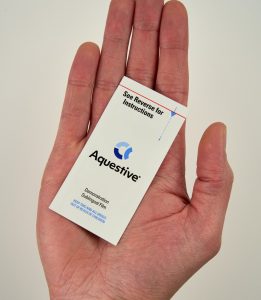
Anaphylm – or dibutepinephrine sublingual film – is about the size of a postage stamp comes in a slim foil pouch.
The new human factors study involved 105 participants who were given Anaphylm with revised labeling instructions and packaging. The study showed significant improvement in speed and ease of use. For example, the median time for participants to open the pouch decreased from 17 in an earlier study to 3 seconds. Participants also showed more success correctly using the oral film with the new instructions.
Aquestive’s Human Factors Study
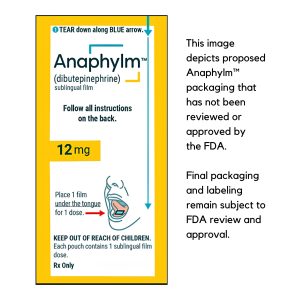
The film’s proposed new pouch features a simplified one-step process to open. Unlike the original packaging, it also now includes an image showing correct under-the-tongue placement. The study participants, who received no training, included adult and pediatric patients, school nurses, emergency medical technicians, and passersby.
The study captured the participants’ ability to open the pouch, use the film, and understand the instructions. Aquestive says its study of the new packaging shows improvement from its original human factors study in a few ways. In addition to the faster times opening the pouch, the median time it took to open and administer the first dose decreased from 46 seconds to 17 seconds.
The ease of opening the pouch also improved. According to the new study results, only one out of 105 participants had difficulty opening the pouch as opposed to 26 out of 166 in the previous study.
The number of participants who incorrectly placed Anaphylm in the mouth decreased from 20 out of 166 to two out of 105. Additionally, no participants were observed chewing the film or removing the film after use, according to the results.
Pharmacokinetic Study of Epi Film
In the pharmacokinetic study for the FDA, the research team compared in 48 participants when Anaphylm was administered by the patient vs. when a medical professional placed it for the patient.
The study also included some instances of intentionally using the sublingual epinephrine film incorrectly. For instance, applying it on top of the tongue.
“One of the more encouraging aspects of the study was the information generated under conditions that do not reflect the intended method of administration,” Greenhawt says.
The researchers looked at epinephrine exposure and absorption with the incorrect placement. The exposure to the medication was lower when the film was used on top of the tongue. However, Aquestive says the results then showed the film’s epinephrine absorption into the bloodstream was comparable to manually injected epinephrine.
“We were encouraged to observe a measurable and clinically meaningful pharmacodynamic response,” Greenhawt says.
The study measures the concentration of epinephrine in the blood, along with the time it takes to reach maximum concentration. For example, self-administered Anaphylm took 12 minutes to reach maximum concentration compared to 45 minutes for epinephrine administered by a clinician via syringe injection. It took 35 minutes for the incorrectly used Anaphylm to reach maximum concentration.
“Correct administration in accordance with FDA-approved labeling, if approved, would remain essential,” Greenhawt says. “But these data provide useful information for FDA’s review regarding product performance under the studied conditions.”
Applying for FDA Approval

The results from both of the new studies will be included in the company’s resubmission to the FDA of its new drug application. Aquestive is seeking approval for use in adults and children weighing 66 pounds and more.
“Taken together, these findings provide additional support for the usability data observed in the studies and will help inform FDA’s review of the planned NDA resubmission,” Greenhawt says. “Ultimately, our goal is to help ensure that people at-risk have a treatment option that can be used quickly and confidently when it matters most.”
Once it receives the Anaphylm application, the FDA has six months to review. Barber says the company plans to seek an expedited review, although the FDA makes the decision on whether to undertake that.
Until there is a regulatory decision, it is premature to discuss product launch timing, CEO Barber notes.
But he confirmed to Allergic Living that the company is “continuing appropriate launch readiness activities across the organization in preparation for a potential approval.” Additionally, decisions about pricing will be made closer to launch, if Anaphylm is approved, Barber says.
“Our current focus remains on completing the NDA resubmission and supporting the regulatory review process,” he says.
Plans to bring Anaphylm to Canada, Europe and the United Kingdom also are on track. Aquestive plans to submit those applications for approval for the second half of 2026. Those regulators have not required additional studies.
Related Reading:
CEO Sees Clear Path Ahead After FDA Rejects Anaphylm Epi Film
Stock Epi at School: Why Laws are Changing Across the U.S.