
Aquestive Therapeutics has resubmitted its under-the-tongue epinephrine film to the Food and Drug Administration to be considered for approval.
Anaphylm, the brand name for the dibutepinephrine film, is for the treatment of serious allergic reactions, including anaphylaxis. The film, which is about the size of a postage stamp, dissolves quickly when placed under the tongue.
“We know the need remains significant, and we are really excited to be a significant step closer to bringing this to patients,” Daniel Barber, Aquestive’s president and CEO, told Allergic Living.

The FDA may take up to six months to review Aquestive’s new drug application, which could mean a decision by mid-March 2027, Barber says. “We have also requested expedited review as part of the resubmission process and look forward to working with the agency throughout its review,” he says.
Aquestive is seeking approval for use of Anaphylm in adults and children weighing 66 pounds and more.
If approved, Barber says the company plans to have Anaphylm available in pharmacies within a few weeks. The company is hiring a sales team in preparation to launch. “We should be able to do it very rapidly,” Barber says.
Dr. David Golden, lead author of the 2023 Anaphylaxis Practice Parameter, said Anaphylm’s “small, highly portable” size and needle-free delivery “has the potential to address important barriers associated with carrying and administering epinephrine.”
“Importantly, Anaphylm has previously demonstrated a rapid onset together with robust increases in heart rate and blood pressure,” said Golden, a member of Aquestive’s scientific advisory board. “These pharmacodynamic responses were comparable to or greater than those observed with auto-injectors and manual IM epinephrine in clinical studies.”
Golden says these characteristics suggest that “Anaphylm, if approved, could represent a meaningful advancement in the treatment of severe allergic reactions.”
Anaphylm’s First Application Denied
The resubmission follows a January 2026 decision by the FDA not to approve Anaphylm. In its Complete Response Letter to the company, the agency cited issues related to “human factors.” Human factors refer to whether patients can safely and correctly use a medication as intended, particularly in real-world situations.
The FDA was concerned that some people had difficulty opening Anaphylm’s foil packet or placing the film correctly under the tongue, the company said. In the original human factors study, six out of 166 patients tore the film and four chewed it. Another 20 users placed the film in the mouth, but not under the tongue.
The FDA required Aquestive to conduct new studies related on human factors and usability. They also wanted to see one on pharmacokinetics, which looks at how the drug is absorbed and moves through the body, using the film in the new packaging.
Aquestive has completed both studies. The results are included in its resubmission.
New Packaging for Ease of Use
To address the FDA’s concerns, Aquestive modified the pouch and revised the user instructions, Barber said. The new pouch features a simplified, one-step opening process. It also includes an illustration showing where to place the film under the tongue.
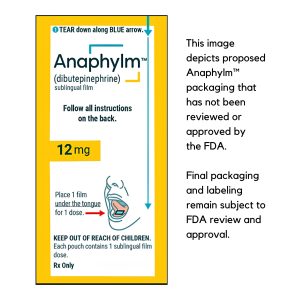
The new human factors study involved 105 participants. They included adults and children, school nurses, emergency medical technicians and members of the public. Participants were not trained on how to use Anaphylm before the study. The packaging changes appeared to make the film faster and easier to administer.
The median time to open the packet fell from 17 seconds in the earlier study to three seconds. The median time it took to complete all steps – opening the packet, reading the instructions, and administering a dose – fell from 46 seconds to 17 seconds.
Only one of 105 participants had difficulty opening the pouch, and no one tore it. The new packaging also reduced incorrect placement.
While 20 of 166 participants in the earlier study placed the film incorrectly, only two of 105 did so in the new study. No participants chewed the film or removed it from their mouths.
What if Anaphylm is Placed Incorrectly?
Aquestive also conducted a new pharmacokinetic (or PK) study to examine how epinephrine from Anaphylm is absorbed into the bloodstream.
Participants either administered Anaphylm themselves, had it administered by a medical professional, or received epinephrine manually using a syringe. The study also included one group in which a clinician intentionally placed the film on top of the tongue instead of underneath.
Self-administered Anaphylm reached maximum blood concentration in a median of 12 minutes, compared with 45 minutes for epinephrine given by syringe.
The results showed that placement affected how quickly epinephrine entered the bloodstream. When Anaphylm was placed on top of the tongue, epinephrine levels rose more slowly and reached a lower peak than when the film was placed correctly under the tongue. The incorrectly placed film took a median of 35 minutes to reach maximum concentration.
However, the incorrectly placed film still produced changes in heart rate and blood pressure. Those are indications that epinephrine is being absorbed and having an effect on the body. Barber says the effects were comparable to those seen with injectable epinephrine.
Dr. Matthew Greenhawt, Aquestive’s chief medical officer, has called the results encouraging. “Correct administration in accordance with FDA-approved labeling, if approved, would remain essential,” he told Allergic Living. “But these data provide useful information for FDA’s review regarding product performance under the studied conditions.”
Anaphylm’s Clinical Trials
Earlier clinical studies have also examined how quickly Anaphylm delivers epinephrine and how the drug affects heart rate and blood pressure, including both single dose and repeat-dose studies.
In a key Phase 3 trial in adults, Anaphylm reached peak blood concentrations of epinephrine in a median time of 12 minutes. That compared with 20 minutes for EpiPen, 30 minutes for the AUVI-Q auto-injector, and 50 minutes for epinephrine administered by syringe.
Another study tested Anaphylm in patients experiencing an oral allergy syndrome (OAS) reaction. In OAS, patients have localized swelling and itching in the mouth, tongue and throat after eating certain raw fruits or vegetables such as apples or kiwi. The FDA had requested that trial because anaphylaxis can also cause severe swelling of the mouth, lips and airways.
In the OAS study, swelling began to ease in as soon as two minutes after receiving Anaphylm. The average time to complete symptom resolution was 12 minutes.
As with other epinephrine products, Anaphylm wasn’t tested in patients experiencing anaphylaxis for safety reasons. Instead, trials were conducted in healthy volunteers or those with OAS. Researchers used epinephrine levels in the bloodstream and changes in heart rate and blood pressure as measures of drug absorption and response.
Related Reading:
Food Allergy Community Up in Arms over Epinephrine on Planes
Stock Epi at School: Why Laws are Changing Across the U.S.