
Research into using fecal transplantation of gut bacteria from healthy donors to treat peanut allergy is moving into its next phase.
Recruitment is nearly complete for the first part of a Phase 2 trial testing fecal microbial transplantation therapy, or MTT, in peanut-allergic teens.
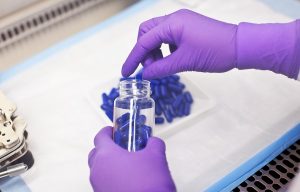
MTT capsules contain purified microbes from the stool of non-allergic donors. While dubbed “poop pills,” MTT capsules are pathogen-free and contain very little stool, says Dr. Rima Rachid. She’s lead investigator and director of the Food Allergy Program at Boston Children’s Hospital.
What the capsules primarily contain are the diverse microbes found in the guts of non-allergic donors. Researchers hope that the microbes will colonize the teens’ intestines, interact with the immune system, and reshape the immune response so they become less reactive.
The Phase 2 trial has two sections. In Part A of the study, 24 peanut-allergic teens ages 12 to 17 will receive either MTT capsules or a placebo. The trial will test whether one month of microbe-rich fecal pills can boost peanut tolerance.
Part B of the study includes a different group of 13 teens. It’s exploring whether MTT can improve the long-term success of oral immunotherapy (OIT).
Fecal Pills Build on Earlier Research
The Phase 2 trial builds on previous research, including a Phase 1 study published in Science Translational Medicine in August 2026. It found a single fecal microbial transplant increased tolerance to peanuts in six out of 15 adult participants.
Rachid says the proof-of-concept study was the first to demonstrate that a microbiome-based therapy may improve food allergy in people while also revealing how gut bacteria, their metabolites, and the immune system work together.
In the trial, all participants reacted to 100 milligrams of peanut (about half a peanut) or less at the start of the study.
The fecal microbiota transplant involved having participants consume 36 capsules containing frozen, purified stool from non-allergic donors over several hours.
During a food challenge at four months, three of the 10 could consume at least 300 milligrams of peanut before having allergic symptoms. That’s a little over one peanut kernel. One participant tolerated 600 mg (about two peanuts) before starting to react. Another tolerated that, then went onto the highest total dose of 1,043 mg without an allergic reaction.
Though it was a small, open-label trial, “we were excited when we saw the results,” Rachid says.
Fecal microbiota transplant is currently used to treat C. difficile, a bacterial infection that causes severe diarrhea and colon inflammation.
Antibiotics and New Microbes
The Phase 1 peanut allergy study involved a further investigation. This showed that giving participants antibiotics to kill off existing microbial colonies appeared to boost the efficiency of the fecal transplant.

Five participants received four days of antibiotics that target bacteria in the digestive tract before receiving the fecal microbial capsules. This created “a niche” for the donor bacteria to establish themselves, Rachid says.
Of the five given antibiotics, three were able to ingest 600 mg of peanut protein before starting to react.
“We are trying to kill off the gut bacteria as much as possible, so when we immediately replace the microbiome with that of a healthy person who doesn’t have allergies, it is possible these bacteria will be able to proliferate rather than compete with the already present bacteria of the person who has food allergies,” Rachid says.
Adverse events were mild and included fatigue, diarrhea, nausea, stomach pain, dizziness and headache.
Rachid says that in the nine patients who didn’t respond, longer treatment or antibiotics in those who didn’t receive them might be needed.
Fecal Pills Head to Phase 2
Antibiotics before treatment will also be part of the Phase 2 trial, which is being co-led by researchers at University of Minnesota. Participants will receive a week-long course of vancomycin and neomycin.
The Phase 2 MTT capsules now contain under 1 percent of non-microbial fecal matter. Rachid says that’s much less than what the original capsules contained. They can also be stored in the refrigerator, whereas the originals had to be kept frozen. “That makes it much more approachable, feasible and acceptable” for patients, she says.
In Phase 2, participants in Part A of the study that’s testing peanut tolerance will take five fecal-microbe pills on each of the first two days of treatment. They’ll then move on to two capsules daily for 26 days. The others will receive placebo capsules. They will undergo a food challenge at one month and four months.
In Part B of the study, the other group of teens will undergo one year of OIT, including a buildup phase before settling on a maintenance dose.
After one year, patients will take antibiotics for a week. They will then continue with their maintenance OIT dose, while receiving three months of daily MTT capsules.
They will then discontinue both OIT and MTT for 12 weeks. Afterwards, a food challenge will determine if the OIT and fecal pill combination leads to sustained unresponsiveness.
That’s when a person with food allergy can safely consume an allergen without reacting, even after stopping regular exposure or treatment. It’s an ambitious goal, and one that would separate this treatment from other long-term food allergy therapies – if it works.
Why Might Microbial Transplantation Work?
Previous studies have suggested the gut microbiome, or the community of bacteria that lives inside the intestines, can either help protect against allergies or encourage their development.
In a 2019 Nature Medicine study, Rachid and colleagues found differences in the gut microbiomes of babies with and without food allergies. When researchers transplanted the babies’ stool into egg-allergic mice, the mice that received the allergic babies’ fecal bacteria went into anaphylaxis when they ate egg protein. However, mice transplanted with fecal bacteria from the non-allergic babies did not.
In the recent Phase 1 study, researchers found that participants who responded to the therapy had higher levels of bile acid metabolites than those who didn’t respond. Some of the compounds are produced by gut bacteria.
When researchers transplanted stool samples from responsive participants into peanut-allergic mice, those mice became less reactive to peanut. The protected mice also had higher levels of Bacteroides bacteria.
Researchers believe the bile acid metabolites may help promote a special type of regulatory T cells, which shift the immune system toward tolerance. Consistent with that idea, participants who responded to treatment had more of these regulatory T cells, which help prevent the immune system from overreacting to foods. They also had fewer Th2 cells, immune cells that drive allergic reactions.
Promoting Right Immune Cells
“Food allergy reflects a failure of oral tolerance, the process by which the gut immune system learns to accept food,” says senior author Dr. Talal Chatila, director of translational immunology at Boston Children’s. “What this study shows is that the right bacteria can help restore that process, working through bile acid metabolites to promote the immune cells that enforce tolerance.”
Ilana Golant, founder of the Food Allergy Fund, which helped fund the research, says a treatment that could lead to sustained unresponsiveness deserves further study.
“The larger scientific promise is the possibility of modifying the underlying disease rather than relying exclusively on treatments that must be taken indefinitely,” she says.
Related Reading:
Bile Acids May Impact Who Reaches Food Allergy OIT Remission
Fecal Transplant Pills Show Promise in Treating Food Allergies
Xolair for Food Allergies: the Biosimilars are Coming