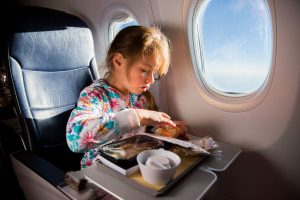
The lack of allergy labeling on in-flight meals has taken an alarming turn that I’ve been warning about. A 5-year-old with nut and egg allergies on July 2 ate a few bites of hummus in Business Class that turned out to contain cashew.
The child’s mother says an American Airlines flight attendant had said the hummus contained neither allergen. As the child developed hives and started to double over with stomach pain, the mom says the attendant then looked up the food on the airline’s app. He discovered it contained cashew.
The mom immediately administered the epinephrine auto-injector and her daughter stabilized. But she says in a testimonial on my No Nut Traveler website, “I still don’t understand why I, as the parent of a child with life-threatening food allergies, was never able to see the meal description or a list of allergens myself so I could make an informed decision.”
I don’t understand it either. In fact, what’s infuriating is that this is the same in-flight hummus with cashew that I’ve been warning about since late April. At that time, the post of a male passenger on American Airlines caught my attention. He too has a nut allergy and had ordered the sliders with carrot hummus. The man suffered an allergic reaction that fortunately was mild.
In his post, he wrote: “I had a rough day from it but didn’t go full anaphylactic. Thank God I hadn’t eaten more than a couple of small bites” [of the hummus]. In a recent testimonial on my site, he notes: “Would you ever think to ask if carrot hummus contained hidden cashews? I did not.”
What’s in AA’s Hummus?
Here’s what’s maddening. Wearing my hat as the airlines correspondent for Allergic Living, I’ve been asking American Airlines (AA) since the man’s reaction to tell us simply: What is in the carrot hummus?
I submitted an official media inquiry three separate times. In an effort to elevate the request, I also emailed individuals in different departments and reached out to additional American Airline contacts on LinkedIn. Despite these efforts, I received only automated acknowledgements from the media department and no response anywhere else.
I was not asking the airline to change its menu or assign blame. Rather, I was trying to get a simple answer to share before another passenger unknowingly accepted a meal that might contain a hidden allergen.
Searching online for the hummus dish information, I found no official source confirming the ingredients. That’s why I wanted to verify it.
I also communicated less formally with the airline on X. On that platform, AA acknowledged my inquiry several times and indicated it was checking with its food and beverage team. Because of those responses, I hoped clarification was forthcoming. Yet, nothing came.
Now, unfortunately, that same hummus dish has caused a little girl to have a severe allergic reaction. Her mother reports being stressed out for the rest of the flight, hoping her daughter’s reaction wouldn’t rebound. Paramedics met them on the jet bridge. Thankfully, the girl recovered fine.
I’ve now asked AA about the girl’s reaction to this hummus and whether efforts will be made to disclose nut ingredients. I’m hoping that, this time, American Airlines will share them.
Airline Meals & Allergen Disclosure
The male passenger’s April 2026 post rang alarm bells because I had seen something similar before. In 2023, while reporting for Allergic Living, I investigated a young woman’s reaction aboard a Delta flight to Copenhagen. Skylar Sloane, who has allergies to nuts and peanuts, had relied on what appeared to be complete allergen information.
Then she reacted, and the flight crew checked but found no menu allergen listings available on the plane. Pesto was the main suspect.
My investigation exposed a regulatory gap: restaurant-style airline meals generally are not required to carry the same allergen labeling as packaged foods. I was told by the Food and Drug Administration that they require in-flight allergen labeling on “prepackaged food”. An FDA spokesperson explained that, if the food is served ‘restaurant-style,’ either uncovered or not sealed into a package, labeling is not required.
I learned of the 5-year-old’s July reaction through disability rights attorney Laurel Francoeur, whom I have worked with on airline-related cases. When I asked the child’s mother why she contacted Francoeur, she said: “I wanted to understand the rules and regulations for airlines and how I could advocate, so this does not happen again.”
Before allowing her daughter to eat, the mom said she asked attendants about allergens. “They told me that all the food was safe and had no nuts or eggs.”
As her child reacted, the mother alerted the flight attendant and gave the epinephrine shot. When the flight attendant looked up the hummus on his app, the mom was shocked to see – cashew was actually in the hummus’s title.
“I can’t understand why I couldn’t see a menu or a list of food allergens to make the decision for my daughter,” she told me.
Allergic But Not Telling
People with food allergies are taught to ask questions before eating unfamiliar foods. But they also make risk assessments based on what appears to be a reasonable expectation of safety. Most people know to ask whether pesto contains tree nuts. Far fewer would think to ask whether carrot hummus contains cashews.
These cases reflect a broader pattern captured in research. In the international survey of 4,700 air travelers with food allergies conducted by the Center for Food Allergy & Asthma Research (CFAAR) at Northwestern University, nearly one-third (31%) reported choosing not to disclose their food allergy to the airline. Among the 400 respondents who reported an in-flight allergic reaction, airline meals were identified as one of the reported triggers.
The finding that nearly one-third of passengers did not to disclose their food allergy is significant. Previous research has shown that some travelers avoid disclosing allergies because they worry about drawing attention to themselves, being perceived as difficult, or facing negative reactions from others.
Many of us traveling with food allergies know that the safest, recommended approach is to bring your own food, not to rely on an airline’s meal. But not everyone has heard this message.
For passengers avoiding allergen disclosure, access to accurate ingredient information becomes even more important. They may be relying primarily on the information available with the meal itself, and not even asking the crew for confirmation.
When a meal appears to be labeled or when reassurance is provided by airline personnel, many travelers assume the information available to them is complete.
Potential for Hidden Allergens
Remember my earlier FDA investigation? Although the FDA encourages ingredient information to be available for airline meals, it does not require the strict allergen labeling that applies to packaged foods. Flight attendants may sincerely believe they have all the available ingredient information. Passengers may reasonably believe the information they receive is complete.
At allergy conferences where I have presented on airlines and allergies, even medical professionals have told me they had no idea that an airplane meal is not required to have a complete ingredient or allergen list. The surprise is not only about a regulatory difference. It is that these meals often appear to be labeled, creating an expectation of transparency that is not, in fact, required.
Three years ago, my reporting on Skylar’s reaction exposed a regulatory gap surrounding airline meal transparency. Today, recent reactions in the skies suggest the consequences of that gap remain.
Hidden allergens are so dangerous – precisely because they are hidden. Travelers with food allergies routinely weigh whether eating an airline meal will be safe or presents the chance of cross-contact in a commercial kitchen. What they cannot do is account for an ingredient they have no reason to suspect is there.
My question about the American’s carrot hummus was never about proving one passenger right or one airline wrong. It was about answering a simple question before another nut-allergic person unknowingly accepted the same meal.
Accurate ingredient information gives passengers with severe food allergies the opportunity to make informed decisions. They deserve that transparency before they eat. It should not become available only after someone has an allergic reaction.
Until complete ingredient information is consistently available, bringing your own food remains the safest choice a traveler with a severe food allergy can make.
Lianne Mandelbaum is Allergic Living’s airlines correspondent, and the founder of NoNutTraveler.com.
Related Reading:
The Trouble with Airline Meals and Food Allergies
FAA’s Awaited Rule on Epi on Planes: Why the Fine Print Matters