
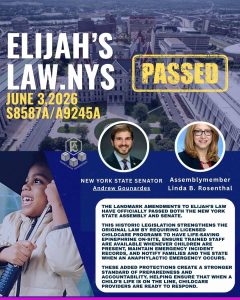
New York lawmakers are working to mandate access to lifesaving epinephrine for the state’s youngest learners and training for their caregivers. The state Assembly and Senate each passed a new bill in June to require childcare centers to have epinephrine devices on site. All that remains is for the governor to sign the bill into law.
The move strengthens New York state’s existing Elijah’s Law. The New York mandate is significant. Several states have taken steps to bolster allergy emergency preparedness for childcare centers, but they’ve focused on “allowing” it, rather than “requiring”.
The amendments (Senate Bill S8587A and Assembly Bill A9245A), which passed June 3, 2026, build on the original Elijah’s Law that New York passed in 2019. The original law focused on food allergy policies, prevention, education, and emergency planning with an option for stock epinephrine, notes Thomas Silvera. He is executive director of the Elijah-Alavi Foundation (EAF).
“These new amendments build on that foundation by removing the option to opt in or opt out, ensuring that preparedness is no longer voluntary,” Silvera tells Allergic Living.
Silvera was instrumental in successfully lobbying for the 2026 amendments, as well as the state’s original Elijah’s Law. New York was the first state to enact the legislation in memory of Silvera and Dina Hawthorne’s son, Elijah-Alavi Silvera.
The 3-year-old died of anaphylaxis in 2017 after he was served a grilled cheese sandwich at his New York City preschool, despite his known dairy allergy. The early learning center then failed to call 911.
“The tragedy was never that our son Elijah had a food allergy,” Silvera says. “The tragedy was that he died because the childcare program entrusted with his care failed to respond appropriately to a life-threatening allergic reaction.”
New York Law Bolstered

Now, the law in Elijah’s honor will gain strength in its efforts to prevent more food allergy tragedies.
“A child’s chance of surviving an allergic emergency should never depend on luck,” Silvera says. “It should depend on a system that is prepared, trained, equipped, and empowered to act without hesitation when every second counts.”
Stock epinephrine is prescribed to be used for anyone experiencing an allergic emergency. In addition, the New York amendments include other requirements for allergy emergencies.
Childcare programs must provide annual training on how to use epinephrine devices and recognize anaphylaxis, and to ensure that trained staff are present when children are in care. The legislation also requires childcare providers to establish emergency response procedures, notify parents, and maintain data about allergy-related incidents.
“What makes New York’s amendments so significant is that they go beyond simply having medication available,” Silvera notes.
New York legislators state Senator Andrew Gounardes and Assemblymember Linda Rosenthal led the efforts to champion a stronger Elijah’s Law.
“As we expand access to childcare to more New York families, we need to ensure childcare centers are safe and accessible for all kids,” Gounardes and Rosenthal said in a joint statement.
“By requiring childcare centers to have life-saving epinephrine on hand and to train staff to use it, we can make life safer and less stressful for kids, parents, and providers.”
City Success Paves the Way
Silvera credits the success of a New York City ordinance with helping to pave the way for the statewide amendments. It “reinforced a broader statewide conversation that preparedness saves lives,” he says.
The local law mandates that all city childcare centers and schools are equipped with stock epinephrine. The city ordinance went into effect in the beginning of May 2026.
“The ordinance demonstrated that requiring emergency medication and preparedness measures was both practical and achievable,” Silvera says. “It showed lawmakers that families, educators, healthcare professionals, and advocates supported stronger protections for children with life-threatening allergies.
If the state amendments that passed in June are signed by New York Governor Kathy Hochul, the legislation will go into effect six months after it becomes law.
“Elijah’s Law, the New York City stock epinephrine mandate, these new amendments, and every law designed to improve allergy safety matter,” Silvera says. “They are about protecting all children and creating a culture of preparedness wherever children learn, play, and grow, from childcare and preschool to elementary, middle, and high school.”
Related Reading:
New York City Mandates Stock Epi in Daycares, Schools
Collaborative on a Mission for Allergy Readiness in Childcare
Childcare: Food Allergy Mom’s Journey from Despair to Hope