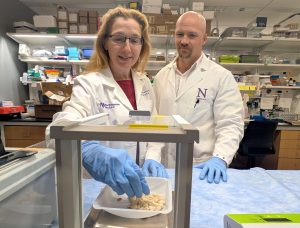
Allergic Living reported last summer on how an older asthma tablet prevented peanut-allergic mice from reacting to peanut. Now, the Northwestern University team behind this research has moved beyond mice, into an early clinical trial in humans.
At the Food Allergy Fund (FAF) Summit in late April, Dr. Stephanie Eisenbarth explained that the drug zileuton blocks inflammatory signaling molecules called leukotrienes. In their mouse study, her lab first discovered that, in the gut, these molecules can be key drivers of anaphylactic reactions.
Zileuton was one of three oral medicines discussed at the summit by a panel on “repurposing” drugs to treat food allergies. The allergist speakers, whose research is funded by FAF, say using drugs approved by the FDA for other conditions can significantly shorten the timeline to an allergy-related approval.
In their mouse study, Eisenbarth’s team found that when zileuton reduced the level of leukotrienes, fewer intact allergens passed through the gut lining and into the bloodstream. The team found that taking zileuton, 95 percent of the allergic mice showed almost no symptoms of anaphylaxis when fed peanut.
At the conference, Eisenbarth, director of the Center for Human Immunobiology at Northwestern Medicine, summed up her team’s goal. The idea with zileuton is to prevent the food-allergic person from absorbing the allergen if consumed by accident.
The allergen “needs to get into your body to trigger the immune inflammation that causes anaphylaxis,” she said. “If we can block that step, we might be able to prevent anaphylaxis to a whole bunch of allergens.”
She thanked FAF for funding the research when “nobody really had these molecules (leukotrienes) on the radar for food allergy.”
Repurposing Diabetes Pill
Also on the panel were Dr. Scott Commins and Dr. Yamini Virkud of the University of North Carolina’s School of Medicine. They spoke about studying metformin, the pill for managing Type 2 diabetes, as a potential food allergy therapy.
Commins’ writing on his work with alpha-gal patients includes reference to six who used metformin ahead of gastric bypass surgery. They were able to resume having dairy products and to return meat to their diets. Meanwhile, University of Cincinnati research in mice has shown metformin blocking allergic responses to egg whites. As well, other research suggests a role for metformin alongside allergy shot treatment (e.g. for dust mites), due to its anti-inflammatory effects.
In food allergy, Commins told the FAF Summit that metformin should be “allergen agnostic”. He explained, “it doesn’t matter whether you’re allergic to peanuts, tree nuts, red meat or egg white.”
His colleague Virkud noted that it was early days for the drug in food allergy. They’re at the planning stages of their pilot study, and hope to start it soon.
Commins, the associate chief for allergy and immunology at UNC, spoke of the advantages of a drug that has already cleared FDA scrutiny. “Metformin is FDA approved down to age 10. So we’re really interested in enrolling children in our study,” he said.
“But you can imagine trying to do that from the ground up with approvals and all the Phase 1 [studies] that would be required. To have years of data that we can pull from to demonstrate safety, it’s a huge win.”
Not All Drugs A Slam Dunk
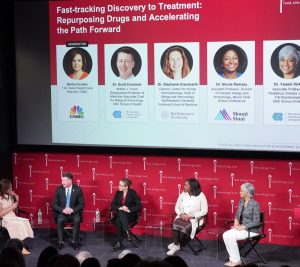
Dr. Nicole Ramsey of the Mount Sinai School of Medicine told the meeting about her work with the more recently approved eczema drug abrocitinib (or Cibinqo). It’s part of a newer class of eczema medications called Janus kinase (JAK) inhibitors.
Interestingly, Ramsey got the idea to study the drug while completing her medical training. She has eczema and food allergies, and had enrolled in a clinical trial for abrocitinib in eczema.
“I had the idea that this medicine might also work for food allergy,” says the assistant professor of pediatric allergy and immunology. “That’s the beauty of these repurposing projects. We have all these medicines already approved in other allergic conditions,” she notes. “They could help patients with more than one condition.”
Her Mount Sinai team’s study, also funded by FAF, has wrapped up. The data analysis is not complete, but she candidly said: “There’s a promising aspect, but it wasn’t a slam dunk.”
She calls the results in food allergy ‘mixed’. “We didn’t meet all of our endpoints, but I think there’s more to the story. We’ll see where we’ll take this medicine next.”
The ‘Why’ of Food Allergies
Slam dunks can be hard to get. What people in the food allergy community sometimes miss is the complexity and variability of the human immune system.
Eisenbarth spoke of the challenge of trying to decipher the “why” of food allergies, which is at the root of trying to prevent and treat them. The FAF panel’s moderator asked: “Is this genetic?” Eisenbarth said genetics only provide a part of the risk profile.
“It is not just genetics. It’s not just environment,” she said. “It’s a combination of those two and other things. The researcher noted that this mixture of allergic influences “makes our jobs a little bit harder because you have to be able to look at the whole picture. There are lots of different pieces.”
The researchers are clearly eager to keep looking at the pieces and looking for answers to make food allergy patients’ lives easier. They noted that their three oral medications are only a small portion of the work that’s going on in food allergy.
Eisenbarth spoke of the “huge acceleration” of food allergy research compared to 10 years ago, while Ramsey alluded to other drugs. Some, she noted, may be even nearer to coming to market.
Related Reading:
Scientists Elated as Drug Zileuton Stops Food Anaphylaxis in Mice
Big Hope a Pill for Chronic Hives Can Also Treat Peanut Allergy