Finding out that the Food and Drug Administration had declined to approve Anaphylm was a blow for Aquestive Therapeutics.
“Emotionally this is a huge setback. It doesn’t feel good at all,” says Aquestive President and CEO Daniel Barber.
Still, after reviewing the FDA’s specific concerns, Barber says there’s a clear path forward. “We have a limited number of issues we need to resolve with the FDA, which we think are very resolvable,” he says. “Timeline-wise, we think we can resolve those fairly rapidly and get the product to market.”
On February 2, Aquestive Therapeutics announced it had received a complete response letter for Anaphylm, its dissolving epinephrine film for treating severe allergic reactions. A complete response letter is the FDA’s formal notice explaining why a drug or device can’t be approved in its current form. It also outlines what the agency needs to see before reconsidering the application.
In an interview with Allergic Living, Barber discussed the FDA’s concerns, and how the company plans to address them.
What is the FDA Questioning?
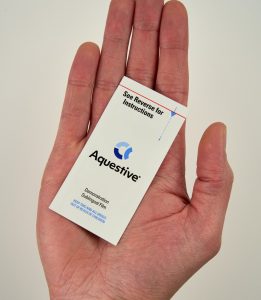
Anaphylm, the brand name for dibutepinephrine sublingual film, is about the size of a postage stamp. The film comes in a foil pouch that’s about the length of a credit card. It’s meant to be placed under the tongue, where it dissolves on contact with the mucous membrane. The company is seeking approval for use in adults and children weighing 66 pounds or more.
As part of its new drug application, Aquestive conducted a human factors study involving 166 participants. The study tested whether they could use the medication correctly in a simulated anaphylaxis scenario. Some were given instructions on how to use Anaphylm; others were just given the film without guidance. This is typical for a human factors study.
In the complete response letter, the FDA flagged instances in which participants struggled to open the foil pouch or tore the film while doing so. The agency also cited cases where participants placed the film incorrectly in their mouth or chewed it.
Barber notes that it took on average 17 seconds to open the package. Only one adolescent participant was unable to open it. Out of 404 doses, there were six instances of torn film. All still delivered a full dose of epinephrine, he says.
Four participants chewed the film, 19 placed it on top of their tongue instead of underneath, and one placed it on the roof of the mouth.
Anaphylm: 2 New Studies

To cut down on user errors, the FDA is asking the company to revise its packaging and labeling instructions. The company must then conduct a new human factors study using the updated materials. The agency also wants to see a study showing whether chewing the film or placing it incorrectly affects how quickly and how much epinephrine is absorbed.
Neither of these studies is a major hurdle, Barber says.
The company already had an alternative package design that they plan to use in the new human factors study, which it hopes to begin by June 2026. The updated pouch replaced the current, two-step folding and tearing process with a simplified, one-step process. It also now includes an image showing correct placement under the tongue.
The FDA also asked the company to clarify that the film should be used even if its torn, and to remind patients to open the pouch with dry hands.
Barber notes that the FDA does not expect there to be zero user errors. Patients make mistakes with epinephrine auto-injectors, for example, by accidentally injecting it into their hand. “This is definitely not about error elimination. That is impossible for any product,” Barber says. “This is about managing errors to be as small as possible.”
What if You Swallow Anaphylm?
Additionally, “we have demonstrated through our clinical studies that there is a wide range of acceptable placement for the film,” Barber says. For instance, the company has already studied what happens when Anaphylm is swallowed. Those results were provided to the FDA.
Swallowing the film still delivers the full dose of epinephrine, but more slowly – reaching peak blood levels in about 25 minutes compared with 12 minutes when the film is properly placed. “You see a delay to the peak levels, but you still get an efficacious dose,” he says.
On an investors call, Barber described the FDA’s request for an additional study on chewing or incorrect placement as “unnecessary and repetitive.” But he added that the company has “no issue with performing this work and providing it” to the FDA.
Crucially, Barber says the FDA isn’t questioning whether Anaphylm delivers epinephrine effectively. The agency has not asked for new clinical efficacy trials on for either the single dose or repeat dose.
“The core of any drug is, is it safe and is it efficacious?” Barber says. “We clearly have closed both of those out in our review process.”
Tolerability Questions in Children
The FDA has also asked the company to further address what it calls “potential tolerability issues” in pediatric patients, though it did not request a new study or specify how the issue should be addressed.
The FDA cited reports of “tingling,” “burning,” or unpleasant taste that could cause patients to spit out the film, as well as a “high rate of local adverse events” in the Phase 3 trial. The company notes that one participant out of 142 withdrew due to tremors and a reaction at the site of administration. All patient-reported adverse events were mild and resolved on their own.
Barber believes the agency is seeking reassurance that children will keep Anaphylm in place long enough for absorption, “which is a fairly brief period of time.”
In clinical trials, he notes that no participants removed the film. In the human factors study, four people did: two did this due to burning and two for taste.
“Keep in mind, these participants were in a low-risk, healthy environment and had no need for the medication,” Barber said on the investors call. One study participant who removed the film said, “I don’t like the taste of mint. But if we had to save my life, I’d even leave the film in for 10 minutes.”
What Comes Next
Aquestive plans to request a Type A meeting with the FDA before launching the new studies. They’re aiming to resubmit their application in the third quarter of 2026. The FDA will then have up to six months to review the application. Barber says the company plans to ask for an expedited review.
“We do think this is the final mile to get to an approval so patients can have the benefit of our product,” Barber says.
Film’s Clinical Trials
If approved, Anaphylm would be the second needle-free epinephrine product. The first is neffy, the nasal epinephrine spray.
Aquestive’s application was supported by a clinical trial program involving more than 400 participants in 11 studies, with nearly 1,000 administrations, including 840 single-dose and 127 repeat-doses.
In its key Phase 3 trial in adults, Anaphylm reached peak blood concentrations of epinephrine in a median time of 12 minutes. That compared with 20 minutes for EpiPen, 30 minutes for the AUVI-Q auto-injector, and 50 minutes for epinephrine administered by syringe.
As with other epinephrine products, Anaphylm wasn’t tested in patients experiencing anaphylaxis for safety reasons. Instead, trials were conducted in healthy volunteers or those with oral allergy syndrome. Blood epinephrine levels, along with changes in heart rate and blood pressure, were used as indicators of epinephrine absorption.
Related Reading:
Epinephrine Film Offers Oral Allergy Relief in Few Minutes: Study
FDA Approves Low-Dose Neffy Epinephrine Spray for Young Kids