The Food and Drug Administration (FDA) has declined to approve Anaphylm, the dissolving epinephrine film for treating severe allergic reactions.
In its complete response letter, the FDA cited issues related to “human factors.” The FDA found that one study raised concerns over whether patients can safely and correctly use Anaphylm in stressful, real-world situations. With the under-the-tongue epinephrine film, those included “instances of difficulty opening the pouch and incorrect film placement that could pose safety risks,” according to the manufacturer, Aquestive Therapeutics.
To address these issues, Aquestive has modified the pouch and instructions for use, said Dan Barber, the company’s president and CEO. The company will conduct a new human factors validation study using the modified product.
Aquestive will also address any “potential tolerability issues” when it resubmits its new drug application to the FDA. The resubmission is targeted for the third quarter of 2026 and the company will ask the FDA for a rapid review.
“We believe that, with the clarity we now have from the FDA, we have made significant progress toward approval,” Barber said. “We remain confident in the effectiveness and safety of Anaphylm and its potential as an easy-to-use, easy-to-carry, fast-acting epinephrine treatment.”
The FDA is requiring that Aquestive conduct two studies related to human factors and usability validation. These can be conducted simultaneously. Importantly, Barber says his team is encouraged that the FDA did not require any new study on the efficacy or overall safety of Anaphylm.
A complete response letter is the FDA’s formal notification to a company that a product cannot be approved in its current form.
Hope for Approval of Epinephrine Film
Dr. Jay Lieberman, an allergist at LeBonheur Children’s Hospital in Tennessee, said the FDA’s response is “focused on patient experience issues and their potential impacts,” rather than effectiveness.
“I am confident in Aquestive’s ability to address the issues described above, and remain optimistic in having Anaphylm available for my patients in the future,” said Lieberman, a professor at the University of Tennessee Health Science Center. “Given the continued underuse of epinephrine in anaphylaxis, the availability of more treatment options remains a top priority.”
The FDA’s decision wasn’t a complete surprise. Earlier in January, Aquestive announced that it had received a letter from the FDA identifying “deficiencies” in the new drug application for the epinephrine film.
At that time, the company said it did not yet know the specifics and was in discussions with the FDA to find out. The FDA’s deadline to issue a decision on the application was January 31, 2026.
“We look forward to working with the FDA to achieve approval for Anaphylm,” Barber said. “Our commitment to bringing this innovative therapy to the allergy community remains steadfast.”
Anaphylm’s Clinical Trials

Aquestive is seeking FDA approval of the under-the-tongue epinephrine film in adults and children weighing 66 pounds or more. Anaphylm is the brand name for dibutepinephrine sublingual film.
Aquestive’s application was supported by a clinical trial program involving more than 400 participants in 11 studies, with nearly 1,000 administrations, including 840 single-dose and 127 repeat-doses.
In a key Phase 3 trial in adults, Anaphylm reached peak blood concentrations of epinephrine in a median time of 12 minutes. That compared with 20 minutes for EpiPen, 30 minutes for the AUVI-Q auto-injector, and 50 minutes for epinephrine administered by syringe.
Another study tested Anaphylm in patients experiencing an oral allergy syndrome (OAS) reaction. In OAS, patients have localized swelling and itching in the mouth, tongue and throat after eating certain raw fruits or vegetables such as apples or kiwi. The FDA had requested that trial because anaphylaxis can also cause severe swelling of the mouth, lips and airways.
In the OAS study, swelling began to ease in as soon as two minutes after receiving Anaphylm. The average time to complete symptom resolution was 12 minutes.
As with other epinephrine products, Anaphylm wasn’t tested in patients experiencing anaphylaxis for safety reasons. Instead, trials were conducted in healthy volunteers or those with OAS. Blood epinephrine levels, along with changes in heart rate and blood pressure, were used as indicators of epinephrine absorption.
Allergy Community Interest
There’s strong interest within the allergy community in needle-free alternatives to epinephrine auto-injectors. The first-approved alternative is neffy, the nasal epinephrine sprayer.
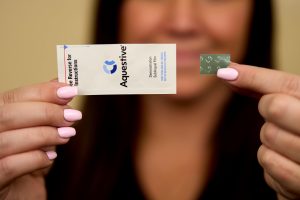
Anaphylm, which comes in a slim foil packet, could be slipped into a pocket, wallet or a mobile phone case. That could make it more convenient to carry than an auto-injector.
Physicians recommend patients at risk of anaphylaxis carry two auto-injectors or nasal epinephrine sprayers at all times. Yet studies show many people don’t always carry auto-injectors.
Aquestive is also moving ahead with plans to bring Anaphylm to other countries. In Europe, regulators from the European Medicines Agency have told the company that no additional clinical trials are needed before submitting the drug for approval. Aquestive plans to apply for approval in Europe and Canada in the second half of 2026, and expects to hear back from U.K. regulators in early 2026.
This article will be updated later today. Please check back.
Related Reading:
Aquestive’s Anaphylm Epi Film Shows Positive Results in Kids