Aquestive Therapeutics’ dissolving epinephrine film was rapidly absorbed and had effects in children similar to those seen in adults. The results from the first pediatric study provide the data needed for the FDA to consider approving the film in children, the company says.
The Phase 1 trial enrolled 32 kids ages 7 to 17 who weighed at least 66 pounds and had a history of severe allergic reactions. Each child received a single 12-milligram (mg) dose of Anaphylm, placed under the tongue.
Researchers measured levels of epinephrine in the blood, an indicator of absorption. They also measured changes in heart rate, blood pressure, and overall safety.
Importantly, the study found the children’s responses were comparable to those seen in adults during earlier trials. This suggests that the findings from adult trials translate reliably to pediatric patients, says Daniel Barber, Aquestive’s president and CEO.
“This study gives us the data to show the FDA that exactly what they expected to have happen is exactly what we saw in our study,” Barber says. “And we also saw that the safety profile was what we expected. The vast majority of adverse events were mild and transient, and the product was safe and well-tolerated.”
The FDA accepted Aquestive’s new drug application for Anaphylm in June 2025. The company is seeking approval of the film in both adults and children weighing 66 pounds or more. This trial was necessary for the FDA to consider approval in the pediatric age group.
A decision from the FDA is expected by January 31, 2026.
“We are extremely pleased with the positive results from our pediatric study, which further validate Anaphylm’s potential as the first-ever sublingual film and convenient treatment option for all patients with severe allergic reactions, including anaphylaxis,” Barber says.
Rapidly Dissolving, Fast-Acting
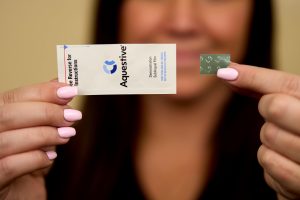
About the size of a postage stamp, Anaphylm adheres to the moist surface under the tongue and dissolves within seconds.
In a key Phase 3 trial in adults, Anaphylm reached peak blood concentrations of epinephrine in a median time of 12 minutes. That compared with 20 minutes for EpiPen, 30 minutes for the AUVI-Q auto-injector, and 50 minutes for epinephrine given by syringe.
In the pediatric trial, the time to reach peak concentration of epinephrine wasn’t significantly different from what was found in adults. Similarly, there were no statistically significant differences between adults and pediatric patients in the effect on blood pressure or heart rate.
Adverse events were short-lived and mostly mild. Patient-reported side effects included numbness, tingling, discomfort or pain at the film administration site, and stomach upset, such as nausea or vomiting.
Physicians reported a few cases of mild irritation, redness or a sore in the mouth where the oral film was administered. The trial was open-label, meaning both the participants and researchers knew they were receiving the drug.
Anaphylm’s Supporting Evidence

Aquestive previously tested Anaphylm in patients experiencing mouth swelling due to oral allergy syndrome (OAS). That allergic condition causes localized swelling and itching in the mouth, tongue and throat after eating certain raw fruits or vegetables such as apples or kiwi. The FDA requested that trial, since anaphylaxis can cause severe swelling of the mouth, lips and airways.
In the OAS trial, swelling started to ease in as soon as two minutes after receiving Anaphylm. The average time to complete symptom resolution was 12 minutes.
As with all epinephrine products, Anaphylm trials weren’t conducted in patients experiencing anaphylaxis due to safety concerns. Instead, trials were conducted in healthy volunteers or in those who triggered mild OAS by chewing (then spitting out) fruit. The trials measure epinephrine concentration in the blood, and changes in heart rate and blood pressure, which indicate epinephrine absorption.
If approved, Anaphylm would become the second needle-free alternative to epinephrine auto-injectors in the U.S. The first is ARS Pharmaceuticals’ neffy nasal spray. Its 2 mg epinephrine nasal spray for adults and kids weighing at least 66 pounds was approved in August 2024. A lower-dose neffy for children 4 years and older and weighing 30 to 66 pounds was approved in March 2025.
Getting Ready to Launch
Barber says the company is preparing to launch in anticipation of a positive FDA decision. If approved, Anaphylm should be available by March 2026.
Each film will come in a foil packet that fits in a wallet, pocket or mobile phone case. Stability studies have shown Anaphylm maintains potency even after exposure to high temperatures.
If the FDA approves the 12 mg dose for adults and older children, Aquestive plans to seek approval for a lower-dose version. This would be for smaller children weighing 30 to 66 pounds. The formulation is already determined, so “we should be able to make rapid progress on that,” Barber says.
How the Oral Film Works
Anaphylm doesn’t contain epinephrine itself. Instead, it delivers a prodrug called dibutepinephrine. This is a chemical precursor to epinephrine that’s naturally converted into active epinephrine when it’s absorbed into the bloodstream.
The chemical formulation of dibutepinephrine allows it to be efficiently absorbed through the mucous membrane of the mouth.
Results from the pediatric study were presented at the 2025 American College of Allergy, Asthma & Immunology (ACAAI) Annual Scientific meeting.
Related Reading:
FDA Approves Low-Dose Neffy Epinephrine Spray for Younger Kids
How Does Epinephrine Turn Off an Allergic Reaction?
FDA on Top Allergen Labels: Coconut Off List, Milk Sources Expand