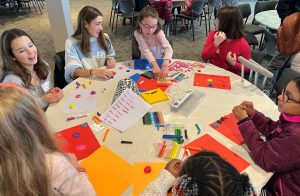
Young children watched with rapt attention as Olivia Wolfe, 15, demonstrated how to use epinephrine auto-injectors and epinephrine nasal spray. As they chatted with their teen mentor about the lifesaving medication, not one of the kids with food allergies at the table seemed frightened.
Instead these kindergartners and first-graders were highly engaged. They grabbed their craft supplies and quickly got to work creating a poster about the science of food allergies. Olivia and her young group took on the role of exhibit curators at the Museum of Science in Boston as part of a novel mentorship program event.
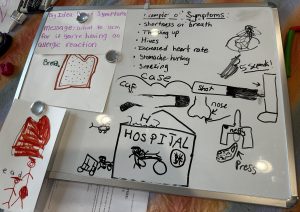
Teams including Olivia’s created posters and 3D models featuring epinephrine, mast cells, food proteins, or examples of cross-contact. They then presented their creations to parents.
The museum event, held on a Sunday in December, is part of the Food Allergy Buddies Program. The program was developed by the Mass General Brigham for Children’s Food Allergy Center in Boston.
“Olivia wants these kids to feel safe and not be afraid of their food allergies,” her mom Jennifer Wolfe tells Allergic Living. “The young kids were so excited to be there. You could see the joy on their faces.”
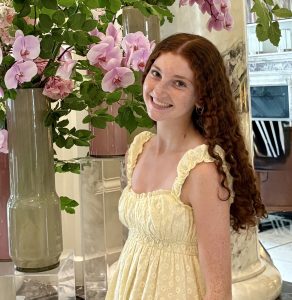
Olivia, of Natick, Massachusetts, is a “Big” in the program. It pairs high school student mentors with elementary (Littles) and middle (Middles) school children who have food allergies. The high school sophomore started as a “Little” in the program when it first launched back in January 2020.
“When I was younger, the Bigs always helped me to feel more confident. They let me know that I’m not alone in this world,” says Olivia. She is allergic to milk, egg, tree nuts and sesame. “Now as a Big, I get to help the younger kids feel more confident and to connect over their similarities.”
Empowerment and Community
The connections kids of all ages make with others with food allergies are central to the success of the free mentorship program. Participants are making new friends, finding role models, and gaining self-assurance from helping others.
“There is something for everyone,” says program director Dr. Michael Pistiner. He is director of food allergy advocacy, education and prevention for the Mass General Brigham for Children’s Food Allergy Center.
Now, there are even plans to take the growing program to the digital space. Kids across the U.S. may soon be able to pair with their own online allergy mentor.
Food allergy mom Cindy Belmonte of the MetroWest area of Boston has witnessed the positive impact of mentorship since the program began. Her daughter Victoria is now a Big in the in-person program.
Victoria, 15, remembers the joy she felt at age 9 when she joined the program as a Little. Her favorite part was “making friendships with other kids with food allergies.” Victoria, who is allergic to dairy, egg, peanuts and tree nuts, told her mom, “They get it,” after her first Buddies event.
“This phase was a time of connection that transformed fear into empowerment,” Victoria’s mom says.
Pistiner finds parents benefit by seeing their own children flourish, while feeling reassured watching older kids lead with self-confidence.
Jennifer Wolfe enjoys chatting with the other parents and comparing ideas on traveling with food allergies or finding accommodating restaurants. “The parents do love it just as much as the kids,” Wolfe says. Belmonte agrees: “The most meaningful aspect has been the extraordinary sense of community.”
Taking Allergy Buddies National
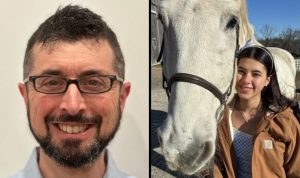
New collaborations are helping to fuel an expansion of the community. The Buddies program, which draws participants from the greater Boston area and beyond, launched with 28 Bigs and 59 Littles in 2020. Now, the mentor program has more than 170 kids registered.
Pistiner attributes some of the growth to a partnership that began in 2025 with the nurses in the Boston Public Schools. They’ve worked to share information about the Buddies Program.
And now, Pistiner and his team are planning to empower food-allergic kids throughout the United States. They are partnering with the Asthma and Allergy Foundation of America (AAFA) to launch a national digital version of the program for the fall 2026 school year, Pistiner says.
“The Food Allergy Buddies Program gives kids with food allergies practical skills and peer support to navigate daily life with more confidence,” Kenny Mendez tells Allergic Living. Mendez is AAFA’s president and CEO.
The collaboration aims to tailor the individual attention that the Buddies Program is known for to work remotely, via computer camera. Planning efforts are focused on how to foster meaningful connections between Bigs and their Littles in an online format.
Pistiner is excited to bring the program to AAFA’s large online community. While he is directing the content, AAFA is developing the digital infrastructure. “AAFA is proud to support this work and excited to help more families access the kind of peer mentorship Food Allergy Buddies provides,” Mendez says.
Buddies Program Fosters Teamwork
In the Mass General in-person program, Pistiner and other experts talk to parents about what their kids are learning during an event. This way, the parents are prepared to answer any questions that might come up later.
“We feel incredibly supported by the expertise of the doctors, in particular Dr. Michael Pistiner,” Belmonte says. “He doesn’t just treat patients, he empowers them and their families.”
Kids and parents get a chance to connect at the Boston program’s four main events each year. Next up with be ice skating in early March, then a scavenger hunt back at the museum.
The events are structured so that teams led by a few Bigs include one or two Middles who help with about six Littles. The Littles are divided into three age groups, so activities can be developmentally appropriate.
The program’s experts offer lesson plan information as a foundation for each event. But it’s the Bigs who take the lead on running the activities tailored to the Littles. “Giving the high school kids and middle schoolers more autonomy over the activities has been amazing to watch,” Pistiner says. “These kids are rising to the occasion.”
For example, the Bigs lead the annual ice skating event. With many in attendance who have never skated before and no parents allowed on the ice, the kids find a way to help each other.
Being brave on the ice offers a real-world example that relates to needing to be brave sometimes while living with food allergies, Pistiner says.
Instilling Confidence
Like Victoria and Olivia, kids often start in the Buddies Program as a Little. They keep coming back with their roles, abilities and responsibilities changing each year, Pistiner explains.
When the big kids act as mentors, “we are hopefully giving them the confidence and capability to then improve the way they care for themselves,” he says.
Victoria’s mom has witnessed that growth. “Watching Dr. Pistiner and his team give these teens the skills, independence, and support to make a difference in other children’s lives is invaluable,” Belmonte says.
Victoria wants the younger kids to understand that food allergies can be hard sometimes, and it’s OK to feel frustration or sadness. The high school freshman finds it important to acknowledge “that allergies are part of who you are, and that adapting to them can actually be fun and creative.”
Olivia’s mom credits the Buddies Program with teaching her daughter to advocate for herself, such as when ordering at a restaurant. Her mentors also helped her work through some nerves about food allergies when she started middle school.
While Olivia is now inspiring younger kids in the Buddies Program, the Littles continue to bolster her self-assurance. “Although I am much older, they always seem to help me feel better about myself and boost my confidence each time we meet.”
Related Reading:
Food Allergy Mentoring Proves a Powerful Support for Parents and Kids
Food Allergy OIT and Competitive Sports: It Can Be Done