
The nasal epinephrine spray called neffy works even if you sniff when its administered, new research shows.
In clinical trials, patients were instructed not to sniff when administering the epinephrine spray. But many sniffed anyway, says lead study author Dr. Jonathan Spergel, MD, PhD. Sniffing can be a natural response when something is sprayed into the nose.
“Many people sniff when they do a nasal spray by reflex,” Spergel says. He’s chief of the allergy department at Children’s Hospital of Philadelphia.

In this study, researchers wanted to test that sniffing wouldn’t affect absorption. They had 42 adults use a single 2-milligram (mg) dose of nasal epinephrine. Participants were filmed so researchers could tell the sniffers from the non-sniffers. Twenty-nine sniffed; 12 didn’t. (One additional video was incomplete.)
Those who didn’t sniff had slightly higher average peak blood concentration of epinephrine after dosing. But the difference wasn’t statistically significant.
“It’s very reassuring … that the natural reflex will not affect the efficacy of intranasal epinephrine,” Spergel says.
For comparison, patients separately received a 0.3 mg injection of intramuscular epinephrine. Average peak blood concentrations were slightly lower than for nasal epinephrine, whether sniffed or not.
The current label for neffy recommends against sniffing. But if someone does so unintentionally, “you should not worry,” Spergel says. Patients should not administer a second dose unless symptoms warrant it.
The findings were presented at the 2025 American College of Allergy, Asthma and Immunology Annual Scientific Meeting in Orlando in November.
The Food and Drug Administration approved neffy in August 2024, making it the first needle-free alternative to auto-injectors to treat serious allergic reactions to food, venom or medications. The 2 mg dose is approved for adults and children over 66 pounds. A 1 mg dose for children ages 4 and older who weigh from 33 to 66 pounds was later approved.
Neffy Holds Up in Extreme Heat
A second study presented at ACAAI found that neffy retained much of its potency after exposure to both extreme heat and cold. Researchers tested the 2 mg nasal spray under conditions meant to mimic real-world exposures. These included prolonged high temperatures, and repeated freeze-thaw cycles.
Patients are told to always have epinephrine with them. “In real life, if you are going to have it readily available at all times, it’s going to encounter cold weather and hot weather,” says lead study author Dr. David Golden. He’s an associate professor at Johns Hopkins University School of Medicine in Baltimore.

At 104 degrees F, both the nasal epinephrine spray and an epinephrine auto-injector maintained similar levels of strong potency for two to three months. But by six months, the neffy held up better. It retained 93 percent of its potency, while the auto-injector had dropped to about 80 percent.
At 122 degrees F, both products performed well for the first month. But by two months, the auto-injector’s potency had fallen to about 81 percent, while the nasal spray was at 98 percent. After 3 months, neffy retained 99 percent potency, compared to only 66 percent for the auto-injector.
“Neffy, among its many great features, retains its potency better than auto-injectors,” Golden says. “Auto-injectors are pretty good, but the more you go into extremes of temperatures and for longer periods of time, the neffy is more durable.”
What to Know About Epi Potency
Potency is measured by how much active epinephrine remains in the product. The FDA allows medications to fall within a small range, typically plus or minus 10 percent of the labeled strength. So a product is still considered fully potent if it contains 90 to 110 percent of its stated amount of active drug.
Manufacturers often formulate products slightly above 100 percent initially, to ensure they remain within the acceptable range throughout their shelf life. In the study, both the nasal spray and the auto-injector began just above their labeled strength.
There’s no precise threshold for how much potency is required for a medication to be effective in every circumstance. But generally, “if it has less than 90 percent potency, we should be concerned. If it’s less than 80 percent we should definitely be concerned,” Golden says.
Room temperature is still the recommended storage temperature. At 77 degrees F, the nasal spray maintained nearly all its potency for the full 30 months of the product’s shelf life.
But Golden points out that ideal storage isn’t always realistic. A salesperson might spend most of their day in their car and store their epinephrine device in a glove box. A teen carrying it backpack might leave it in direct sun on a playground or a field.
“It’s nice to have data to demonstrate they can still be effective even when they’ve had these exposures,” Golden says.
Same Nostril Best for 2nd Dose
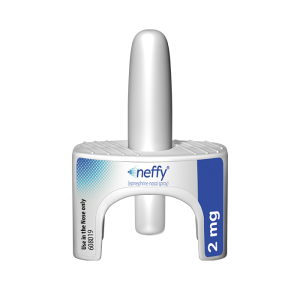
Data show that nine in 10 patients experiencing anaphylaxis improve after a single dose of a neffy sprayer. But roughly one in 10 need a second dose to treat symptoms, which can include hives, itching, swelling, nausea, vomiting and breathing difficulties.
Is it better to dose in the same nostril or alternate nostrils?
If the nose is clear, it doesn’t make much difference, finds a new study also presented at ACAAI. But if the nose is congested from allergic rhinitis, using the same nostril resulted in greater epinephrine absorption.
Participants received two doses of the nasal spray, 10 minutes apart, either in the same nostril or alternating nostrils. Tests were done when participants had clear noses and with severe nasal congestion, provoked by having an allergen sprayed up their nose.
With clear noses, average peak epinephrine levels were similar whether doses were done in the same or alternating nostrils.
In the stuffy nose state, repeating the dose in the same nostril led to higher average peak blood concentrations. Same-nostril dosing also led to the greatest effects on heart rate and blood pressure, both markers of absorption.
Yet even when stuffy nose participants dosed in different nostrils, epinephrine levels “were still in what is thought to be a therapeutic range and similar to injectable epinephrine,” says lead study author Dr. Thomas Casale. He’s director of the division of allergy and immunology at the Joy McCann Culverhouse Clinical Research Center at the University of South Florida.
To avoid confusion, physicians should advise patients to use the same nostril if they need a second dose, Casale says. Neffy’s current label recommends dosing in the same nostril when a second dose is needed, as soon as five minutes after the first dose.
Related Reading:
Neffy Epinephrine Spray Rapidly Reversed Anaphylaxis in Children
Reader Service Info: Neffy’s New Co-Pay Program
Allergic Living’s Airlines & Allergies Guide: Domestic