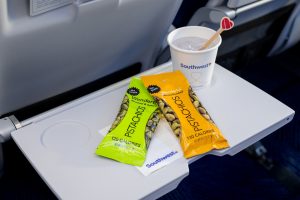
Southwest Airlines recently announced that, beginning January 27, 2026, it will introduce the brand Wonderful Pistachios No Shells as an onboard snack. The airline framed the announcement as an exciting addition to its in-flight perks for those in its extra legroom seats.
However, the news has sparked widespread concern in the food allergy community, particularly for travelers with a pistachio allergy.
I contacted Southwest Airlines with questions about their allergy policy. I asked them to confirm that these snacks were available in a specific seating area and not throughout a plane. Importantly, I asked: if notified in advance of a customer’s pistachio allergy, would Southwest consider suspending service of pistachios either across the flight or in the seating area of the allergic passenger?
I also inquired whether the crew is permitted to make announcements asking nearby passengers to refrain from consuming nut products in these situations.
Southwest responded only to one of my questions. The airline said that “customers seated in Extra Legroom seats will have the option to choose a Wonderful® Pistachios No Shells snack.” The representative added that for those with a tree nut allergy, “we can offer another one of our other onboard snack options.”
This answer is not only incomplete, it is tone deaf. It frames the issue as if the concern is about not being able to eat a snack. Yet, allergy accommodations have never been about snack “preferences”.
The concern I raised was about what steps Southwest would take to protect a passenger with a pistachio allergy. To suggest that passengers with such a severe allergy can “just choose something else” ignores the big question. What will the airline do to mitigate risk when many others are eating pistachios?
Southwest & Nuts: Messaging Confusion
Previously, as captured in Allergic Living’s Airlines & Allergies Guide, Southwest was not offering nut or peanut snacks. This made it one of the go-to airlines for the food allergy community.
A global study revealed the anxiety that many food allergy families experience with air travel. Failing to engage with a serious allergy safety concern amplifies this anxiety. Plus, it shows a troubling lack of awareness of the realities of managing severe allergies in-flight.
The airline excitedly announced on Facebook that it will soon introduce the pistachio bags. The result? Thousands of angry food allergy families weighed in to share their alarm and disappointment.
Allergy advocate Sharon Wong of Nut Free Wok warned on the post that passengers with pistachio allergies who have already booked flights could now be “at risk of anaphylaxis in-flight.” She questioned whether Southwest would offer them refunds. Wong emphasized the “real risk of allergic reactions to cross-contact from shared surfaces” in a confined environment.
Adding to the messaging confusion, a member of my advocacy non-profit No Nut Traveler shared that she had a flight booked for January, just as Southwest introduces pistachios. After calling the airline’s customer service line, she was told that pistachios would not be served on her specific flight because of the allergy.
I asked Southwest to confirm whether the response from the airline staff member on the call reflected an official airline policy or an accommodation just for one individual. I was simply referred back to their initial vague statement.
Airlines: Lack of Allergy Communication
My original intent with asking Southwest the pistachio questions was not to write an article, but to update Allergic Living’s Airlines & Allergies Guide. As it’s become an invaluable resource to those flying with food allergies, we strive to keep it current.
But Southwest’s refusal to provide clear responses deserves discussion as it highlights a troubling reality. It remains incredibly difficult to get straight answers from many airlines about their allergy protocols.
Throughout the long process of developing Allergic Living’s comprehensive airline allergy policy guide, a persistent challenge was obtaining answers to basic, direct questions. When I’d ask whether flight attendants can make allergy-related announcements or whether allergen-containing snacks will be withheld, the result was often generalized or evasive responses. The process demanded relentless follow-up. Sometimes, even then, answers were hard to nail down.
This is precisely why our airlines guide is a living document, and why readers are urged to consult it regularly. Airline policies and onboard offerings are not static. They change, and those changes can present serious issues for allergic travelers. As Southwest’s case illustrates, even when a major allergen is newly added to the menu, clear guidance on allergy safety measures is often nowhere to be found.
Southwest Airlines was once known as the airline that served peanuts. While it no longer offers peanuts onboard, it is essential to correct a common public misconception. The removal of peanuts does not make an airline automatically safe for passengers with food allergies. Peanuts and tree nuts, for instance, are distinct allergens. Yet, both have the potential to cause life-threatening anaphylaxis.
The fact is, Southwest’s recent introduction of pistachios presents a new and avoidable risk to those with tree nut allergies. The lack of a clear risk mitigation protocol only heightens the concerns of the food allergy community.
Southwest’s Pistachios: Uncertainty in the Air
A recent college graduate with nut allergies wrote to Allergic Living that she is a frequent flyer of the airline. But with Southwest’s pistachio plans, Nevada resident Leila Moassessi is extremely concerned about the increased risk of contact with residue. “I’ve reached an unfortunate conclusion,” she says. “With pistachios onboard, I cannot fly Southwest again.”
On Southwest’s Facebook page, another concerned person wrote of the pistachio announcement: “Awful. I have to deal with cancelling a flight now. Extra legroom seat that is booked will be a nightmare. Avoiding this airline entirely.”
Another commentator pointed out that offering pistachios specifically in premium seating effectively prevents someone with a pistachio allergy from safely occupying that section of the plane. “It seems that this policy of offering pistachios only to those in more expensive seating has the effect … of forcing people with food allergies out of those seating areas,” he wrote. Then he added, “Thanks for the second-class treatment.”
These voices speak to the emotional toll and safety concerns created by the decision to serve tree nuts. But it isn’t only passengers who are worried, some medical experts are, too.
For instance, allergist-immunologist Dr. Douglas Jones, who’s president of the nonprofit Food Allergy Support Team, told me the risk extends beyond passengers allergic to pistachios. He notes that cashew and pistachio allergies are highly cross-reactive. This means that those allergic to cashews might also react to pistachios. Jones says cashew–pistachio is one of the most common allergy pairings he has treated over a decade of offering food allergy care. He warned that introducing pistachios could endanger a far larger group of passengers than the airline may realize.
Until Southwest provides a clear, written policy outlining how it will respond when a passenger discloses a tree nut allergy, travelers have to rely on uncertain accommodations.
Allergic Living will continue to update our Airlines & Allergies Guide and press for clarity, consistency, and fairness in airline accommodations. In the meantime, travelers with food allergies are urged to research every flight, speak to gate agents and crew, and advocate for their rights.
Airlines will proclaim that passenger safety is their top priority. Somehow, this commitment often seems not to extend to those with food allergies – a potentially life-threatening condition. It’s way past time for airlines to stop treating allergic travelers as an afterthought. The fact is, they are a growing population of individuals with a serious medical condition. They deserve clear policies, straight answers and consistent safeguards.
Related Reading:
DOT Finds in Favor of Pre-Boarding for Food Allergies
It’s Come to This: ‘Borrowing’ Auto-Injectors on Planes