EveryBite, a digital platform for personalized menus, has launched a partnership with the nonprofit FARE to serve allergy-friendly, interactive menus to food allergy diners.
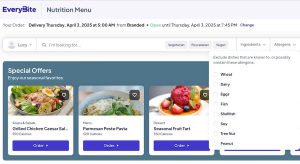
The company has quickly become the largest allergen- and nutrient-filtering platform for restaurants in the U.S. The key to EveryBite is its SmartMenu technology. This allows a diner to filter menu choices based on major allergens, along with ingredients beyond the Top 9.
“Everything else in this world is personalized from Spotify to Amazon, why aren’t menus?” asks F. Sid Conklin, CEO and co-founder of EveryBite.
Already, more than 1 million customers have turned to the menu platform since EveryBite launched in April 2024 at New York-based JRECK Subs. The company has put its technology and data to use in more than 50 restaurant chains and about 4,000 locations in the United States.
Other restaurants include Cafe Zupas, Cracker Barrel, La Parrilla Mexican Restaurant, Steak ’n Shake, TGI Fridays and Wayback Burgers.
“We want our data set to be used to help. We’re trying to help the diner, and we’re trying to help the restaurant,” Conklin says. That help begins with moving beyond stale-dated website menu PDFs and allowing restaurants to update in a few keystrokes.
EveryBite’s first quarterly report, released April 8, 2025, provides detailed analysis of data on food allergy-related dining habits.
FARE is collaborating with the digital firm on these reports, with the aim of benefiting the food allergy community of 33 million Americans. (It says there is no financial component to the partnership.)
Providing valuable insight to the restaurant industry will make “food allergy diners more visible to restaurant operators,” says Sung Poblete PhD, RN, the CEO of FARE. “The result is a dining landscape that not only becomes more welcoming and inclusive, but also offers more and safer dining options for food allergy patients.”
EveryBite: Ingredients, Instant Updates

When a new restaurant is added to the platform, EveryBite analyzes its menu data through a variety of filters before posting it, says Lucy Logan, EveryBite’s president and co-founder. Each time a guest uses the digital platform, their SmartMenu allergen choices are collected as well. This provides insights for the restaurant.
“Literally, with every bite, we gain more data and options for the food-allergic consumer,” Logan tells Allergic Living.
When a customer selects allergen filters on a restaurant’s website, the data-driven software searches dishes’ recipe ingredients. Logan explains that the data run far deeper than the menu item description.
For example, if a menu description for a garden burger says it contains dairy, a customer might assume cheese is on the burger and ask for “no cheese.” However, because EveryBite’s filter system captures data about each ingredient, Logan says it will find if dairy is actually part of the burger itself.
Gone are the stagnant PDF menus that can be challenging to view on a phone and often aren’t updated for months, Logan says. With EveryBite’s software, restaurants can update their menu in minutes. So if there are ingredient changes, such as a different type of sauce, that’s captured right away.
EveryBite’s menu-sync “enables restaurants to make a recipe change in their menu, and have it instantly update to the guest-facing allergen page,” Logan says.
Customizing Meal Choices
Using the SmartMenu technology on the nutrition and allergen page of a restaurant’s website, diners check off which allergens to avoid. Then they sort through the resulting filtered menu choices.
The technology uses a color-coded system to show options, based on ingredients.
The categories are:
- Match (green). Item doesn’t contain any of the ingredients entered.
- Partial match (yellow). Dish contains at least one of the selected ingredients, however there is a chance to modify the item. For example, a diner could select gluten-free pasta to make a pasta dish a match for a wheat allergen filter.
- Not a match (red). Ingredients entered are in the dish.
Ingredient matches for restaurants with a build-your-own concept are automatically reflected on the SmartMenu as the diner makes selections. For example, if a diner with a dairy allergy adds cheese while building a burger online at WayBack Burgers, the item will turn red, saying it does not match “Dairy free”.
Hope for Allergy Awareness
Conklin believes the partnership between EveryBite and FARE marks the beginning of an effort to help change the restaurant industry. His firm’s data can provide restaurants with the tools to understand and cater to food-allergic diners, while growing their own brands, he says.

FARE says the EveryBite reports will provide restaurant chains with insights into the scale of the food allergy community, data on our dining habits and tools to measure the value in creating allergy-aware dining.
Poblete says: “FARE believes it is possible to foster a synergy where food allergy patients have access to more information in a format that is easily, and ideally more frequently, updated.”
“At the same time,” she says, “restaurant operators can better recognize and act on the opportunities presented by food allergy diners.” She calls it “the definition of a win-win.”
Conklin and Logan are aiming to keep that opportunity growing. They hope their platform will reach 250 chains and 25,000 locations by the end of 2025.
Communication Remains Vital
EveryBite’s SmartMenu is meant to streamline the ordering experience, whether that’s done online, in-person or on a restaurant’s device. But the diner and restaurant staff still must discuss the diner’s allergies and the eatery’s protocols for ensuring safety.
“We always recommend that guests still ask the server to confirm their chosen meal meets their unique allergen requirements,” Logan says.
A pop-up disclaimer on each restaurant’s SmartMenu page also reminds customers to inform staff about allergies, and to ask about menu choices and protocols.
Customers also should confirm “if preparation methods have been followed to support minimal cross-contact,” Logan says.
Information about a menu item’s cross-contact risk will be included in the SmartMenu if a restaurant provides it. But that is not yet something that is always provided with the menu information, Conklin says.
Diners can create an account on any participating restaurant’s SmartMenu to save their allergen preferences, Logan says. The information will be saved across the entire network of EveryBite restaurants.
EveryBite: Restaurants Will Profit
The ability for customers to personalize their experience in a way that saves the data, can be a powerful, moneymaking tool for restaurants, Conklin explains.
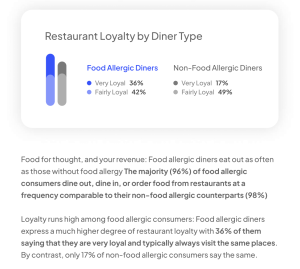
“Allergy diners are the most loyal, they spend the most and will talk about you,” he says. “What restaurant doesn’t want that?”
In fact, EveryBite’s first report finds 36 percent of food-allergic diners are very loyal, compared to 17% of diners without allergies.
“Restaurant operators gain access to a previously invisible consumer group, unlocking new opportunities for profitability while elevating the overall dining experience with safer, more enjoyable options,” Poblete says.
Loyalty translates to profits. EveryBIte’s report states that restaurants see a 24 percent boost in profits when they offer allergy-friendly meals. “There is a huge revenue lift on the back side when you cater to your diner,” Logan says.
In addition to helping EveryBite understand the needs and preferences of food-allergic diners, FARE helped produce the quarterly trends report.
The report tracked activity such as:
- Percent of each allergen filtered. Wheat was the most common with 34 percent.
- Most common allergen combinations. Wheat and dairy (about 2,000 diners); followed by peanut and tree nut (about 1,000 diners).
- Popular menu choices by allergen. For example, spiced chicken verde for peanut-allergic diners.
- Dining activity by region. Fifty-five thousand diners in New York City engaged with the digital platform.
EveryBite’s data can provide restaurants with the tools to understand and cater to food-allergic diners, while growing their own brands, Conklin says. “It’s powerful to let the diner to interact,” he says.
Related Reading:
See EveryBite’s first Diner Trend Report here.
Why All the Food Allergy Tragedies? What Has Got to Change