

About a decade ago, it took a lot of advocacy to achieve state laws allowing stock epinephrine at school in nearly every U.S. state. And now, “stock epi” advocacy is underway again – this time revising these laws to cover needle-free epinephrine.
The original stock epi laws were written when epinephrine meant only one thing: an auto-injector. So now much work is being done to broaden the language of stock epinephrine. This is so state laws also allow schools to stock emerging forms of epinephrine – from the newer neffy epinephrine spray to potentially other needle-free delivery modes.
A driver of change is the neffyinSchools program that manufacturer ARS Pharmaceuticals launched in early 2025. It provides eligible K-12 schools with two free sets of neffy sprayers. But to qualify, your state needs a law that allows for the device.
Richard Lowenthal, ARS Pharma’s president and CEO*, tells Allergic Living that advocates – especially school nurses – are doing a remarkable job in getting expanded stock epi bills passed.
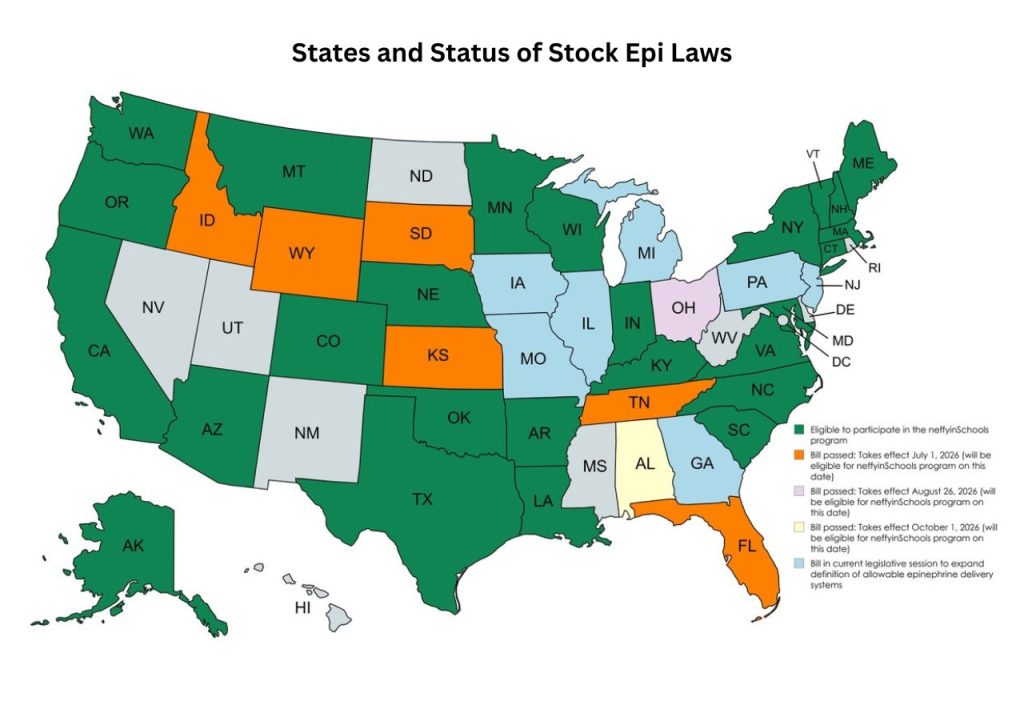
Twenty-six states now have laws in effect that changed language to “epinephrine delivery systems” or “epinephrine devices”. By the end of August 2026, new stock epi laws will take effect in seven more states (see map below), and another is set for October. Plus, seven more states have bills under consideration.
Lowenthal singles out the support of school nurses. He says the ARS Pharma team informed many school nurses about the neffyinSchools program through conferences and webinars.
“We thought, if the nurses know they can get it for free, the nurses would speak to politicians and drive legislation change,” he says. “That’s what happened. The nurses took off with it.”
As well, the Asthma and Allergy Foundation of America provides a tool kit of resources to help those lobbying politicians for stock epi modernization.
California Clarifies Its Law
Stock epinephrine devices have become vital tools for school nurses and trained school staff. Today, stock epi is used to treat about 25 percent of severe allergic reactions that occur at U.S. schools. That’s a significant amount of need for epinephrine devices that have been prescribed to schools, rather than individual patients, for emergency use.
In California, Heidi Hannaman has worked hard to make stock epinephrine a reality ever since the state’s original bill requiring it passed in 2014. The senior policy analyst for the California State Senate is glad to see the neffyinSchools free program. She considers it a strong addition to Viatris’s EpiPen4Schools free auto-injector initiative.
In her state, “I think we will see schools having both devices on hand going forward,” she says.
Hannaman worked alongside Senator Roger Niello to get California’s SB 568 passed in late 2025. It both broadens the stock epi language to “epinephrine delivery systems” and ensures stock epi programs are available for preschoolers. (This was needed due to California’s shift to a universal public pre-kindergarten system.)
“It just made sense to make it ultra clear now that we have new epinephrine technologies coming to market,” says Hannaman.
“There are no grey areas for schools when it comes to liability – they need explicit clarity and we were happy to provide it,” she says. Bill sponsors included the California School Nurses Organization, the Alameda County School Nurses Network and the American Academy of Pediatrics, California.
Nurses’ Stock Epi Experience
San Francisco-area school nurse Joan Edelstein first flagged to Hannaman the need for SB 568. She knows of numerous instances where nurses administered stock epi. Edelstein finds it almost unthinkable to not have it available.
“To be in a situation where you know what a child needs and you’re watching a child not breathe while you’re waiting for 911? That is horrible,” she says. “No child should be in that position.”
“Stock epinephrine can be especially important when a student experiences a first-time anaphylactic reaction or when a student’s prescribed medication is not immediately available,” says the National Association of School Nurses (NASN).
Edelstein, who in addition to being a nurse has long taught school nursing at the college level, has seen both scenarios. In one high school where she worked, a student had a known wheat allergy, yet ate pizza. He had not brought in his own epinephrine. The stock epinephrine saved him in a severe reaction. The teen was one of three students at that school who needed stock epinephrine in under three months.
She and other school nurses spend a lot of time training teaching staff on how to use epinephrine in an emergency, as allowed under California’s law. Staff trained to know the signs of anaphylaxis and administer lifesaving epinephrine are vital, as the school nurse can’t always be available.
A study for the American Academy of Allergy, Asthma & Immunology found that school nurse caseloads across the U.S. range from several hundred to thousands of students.
The 2023 study on school stock epinephrine concerns found that about 25 percent of U.S. public schools have no school nurses. Only 52 percent have full-time nurses. Meantime, about 33 percent employ part-time school nurses, who often cover multiple school buildings.
Staff and Non-Needle Devices
Edelstein says where the neffyinSchools program will have an impact is with the teaching and administration volunteers. For schools where there’s difficulty getting volunteers for anaphylaxis training, “having no needles is going to make a huge difference,” she says. “The big fear is about the needles.”
She has seen this with Narcan. “We generally don’t have difficulty getting people to volunteer to give it because it’s a nasal spray.”
ARS Pharma says almost 12,000 schools across the U.S. have already received neffy sprayers as part of the program. Though the program is young, the stock devices have already been used 237 times.
Lowenthal notes that the stock epi law changes “are really about the indemnification of the school staff.” With almost 25 percent students not diagnosed with an allergy experiencing anaphylaxis at school, he expects this is where the neffyinSchools program will be of lifesaving assistance. Educator volunteers, while trained, want assurance that the law is on their side to treat without a diagnosis.
NASN doesn’t endorse any epinephrine product, but rather stresses the need for access to safe, effective and affordable emergency medications for its members. “As FDA-approved epinephrine delivery options continue to evolve, schools need clear protocols, appropriate training, medical oversight, and product-specific instructions so emergency medications can be administered safely and without delay,” it says.
When it comes to the stock epi laws, Edelstein stresses the importance that California’s law “requires” stock epinephrine at school. The state is in the minority – most state laws still only “allow” for stocking of epinephrine.
“I’m so grateful it’s required here,” she says. “I could be in a district where the school board has decided they’re not going to have it. And then what happens if a child with no known allergy has anaphylaxis? I have nothing to give them.”
Stock Epi Law Tools
- See the map below to find out the status of your state’s stock epinephrine law in allowing non-needle epinephrine devices.
- In a state without a bill or with a bill that’s being considered, see AAFA’s 2025 tool kit. It offers tips and templates for writing to legislators on updating stock epi bills.
- If your child’s school is in a state with a revised stock epi law, share with them the neffyinSchools link, so they’re aware of the change.
- NeffyinSchools offers two cartons (four doses) of neffy for free to all K-12 schools in states with updated stock epi legislation. Get more information here.
- EpiPen4Schools offers two free EpiPen or generic cartons (four doses) for free to eligible schools. Get more information here.
*Donn Casale was named ARS Pharma’s president and CEO in July 2026.
Related Reading:
New York City to Require Stock Epinephrine at Schools, Daycares
Neffy Epi Spray Works Even If You Sniff, Stands Up Well to Extreme Heat