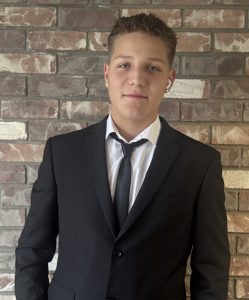
A Canadian teen’s hockey trip turned tragic when the 14-year-old ate a snack that he was unaware contained cashews, to which he was allergic. Malakai Flores suffered a fatal allergic reaction during a weekend of competing on the ice in a sport he loved.
“You never think you’re going to go to hockey and not go home with your kid,” his mom Jerika McArter tells Allergic Living. The two had traveled three hours south from their home in Port Hardy, British Columbia, for a hockey tournament.
Despite normally reading labels carefully and carrying his epinephrine auto-injector, on September 28, 2025, Malakai missed a label and did not have his EpiPen with him. When McArter later arrived home, she found her son’s epinephrine auto-injector in his room. It looked set out to her, as if he’d meant to pack it and accidentally left it behind.
The young goaltender had just finished playing a game at the Comax Valley Sports Centre on Vancouver Island when he and his family went out to run errands. During that outing to a mall, he decided to try a cookie ball from a takeout eatery. The snack would trigger a fatal anaphylactic reaction.
“It was less than 15 minutes from the time it happened to the time of death,” McArter says. In addition to his allergy to cashews, Malakai also had asthma.
Malakai was McArter’s only child. He also leaves behind his dad David Flores, who lives in Los Angeles, along with five siblings through his dad.
Malakai’s Fatal Allergic Reaction
Trouble began for Malakai when he, his mom, and his aunt and uncle went to a local shopping mall. While his mom and her sister ran an errand, the teen and his uncle stopped at Booster Juice, an outlet known for smoothies and snacks.
He said, “Ew, this is gross,” when he took a bite of the cookie ball he had chosen, his mom was told. She says when her son took another bite, he realized something wasn’t right. So the teen went back to the store to check the ingredient information, which was in small print. The label confirmed his fear: cashews were in the snack.
His uncle, who had called McArter (his sister-in-law) to tell her what was going on, asked his nephew if he had his epinephrine auto-injector. When Malakai said “no,” his uncle knew it was time to get help and called 911.
The teen vomited in the restroom and then continued vomiting when they got to his uncle’s truck. As the reaction worsened, Malakai was also struggling to breathe. The family decided to head to the hospital about 13 minutes away, hoping to meet the ambulance on the way.
McArter and Malakai’s aunt jumped in the back of the truck. The family was on the phone with 911 during the drive. McArter says they pulled into a store parking lot when her son became unresponsive.
“I was frantically screaming for help,” McArter says. A passerby helped Malakai’s uncle get the unconscious teen out of the truck so he could perform CPR.
When the ambulance arrived, the emergency responders took over attempting lifesaving measures. More attempts to revive him at the hospital were unsuccessful. Malakai’s mom says his time of death was 5:26 p.m. – while they were in the parking lot.
Mom’s Petition for Epi Access
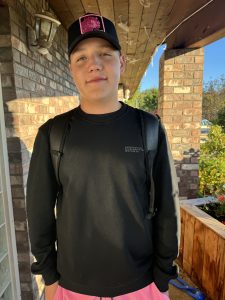
Now, McArter is advocating for widespread access to epinephrine to help prevent another food allergy tragedy. While the teen did not have his personal epinephrine auto-injector with him, his mom believes he could have been saved had epinephrine for public use been available nearby.
“Ideally, he should have had his EpiPen, but accidents happen,” McArter says. “I don’t know what led him to eat something different that day.” She notes that the teen was generally a picky eater, who stuck to a few foods, preferring plain sandwiches or steak without condiments.
McArter has launched a petition, which urges policymakers to ensure epinephrine auto-injectors are available at food establishments, schools, and in first-aid kits. She also wants to ensure that first responders carry epinephrine auto-injectors.
“I would like EpiPens to be more readily available to the public,” Malakai’s mom says. (EpiPens are currently the only epinephrine device sold in Canada.)
Since starting the petition, McArter has heard from so many moms who can relate to being in situations where accidents happen and there is no access to epinephrine.
“I’m doing this in honor of my son. All I can do is try to make change,” Malakai’s mom tells Allergic Living.
Allergy Moms with Common Cause
Georgina Cornago has been advocating for epinephrine access in the United States since her son’s death 2013. Giovanni Cipriano was also 14 years old when he died of anaphylaxis due to his peanut allergy after eating a snack that he didn’t know contained peanut.
Cornago, who couldn’t locate her son’s epinephrine auto-injector during his severe reaction, sees a similarity between her own son and Malakai.
“No parent should ever know the pain of this kind of loss. My heart goes out to this family,” Cornago says. “Every story like this one makes me fight harder to make sure these laws happen. This needs to stop.”
Giovanni’s mom first advocated for Gio’s Law in her home state of New York. The state law, which authorizes firefighters and police officers to carry and administer epinephrine, passed in 2019. On October 8, 2025, Westchester County became the second New York state county to adopt its own version.
Cornago is now taking her efforts to the federal level, with H.R. 4019 introduced in the U.S. Congress in June 2025. It would provide epinephrine access and training to police officers through a federal grant program.
“Better access to education, epinephrine for first responders, and epinephrine in public places everywhere could make all the difference,” Cornago says. “This is why I’ve worked so hard to expand Gio’s Law.”
McArter’s call for public venue access for stock epinephrine devices has precedent. New York state now requires that large public venues, such as ballparks, have epinephrine devices available. In Canada, where McArter lives, Hamilton, Ontario also requires city-owned facilities, such as recreation centers and community halls, to have epinephrine auto-injectors.
Remembering Malakai, No. 31
Malakai’s family, friends and community members have been paying homage to the adventurous teen. He loved playing golf, soccer, and riding dirt bikes, in addition to playing hockey.
The social teen, who was always ready to strike up a conversation with kids and adults alike, found joy on the ice. He started playing hockey back in kindergarten, and had been on the travel team for a few years.
“He loved being with his teammates,” says McArter, adding that he enjoyed the whole experience of being on the team, including the weekend hockey trips.
The loss of Malakai, who was a goaltender for the North Island Eagles U15 team, has been felt throughout his hockey community. His number 31 can be seen in social media tributes to the young player, and the teams are finding ways to honor Malakai on the ice. For example, in two local arenas, teams put a “31” in front of the goalie nets.
Teammates were among friends and community members who gathered in Port Hardy for a standing room-only funeral on October 7.
The GoFundMe campaign set up for his family notes that his death came during a trip doing what he loved most – playing hockey.
“He always stepped on the ice with a big smile,” his mom remembers. “He was so full of life.”
Related Reading:
20-Year-Old Dies of Peanut Allergy – That He Didn’t Know He Had
Neffy Epi Data: Real-World Feedback and Congestion Studies