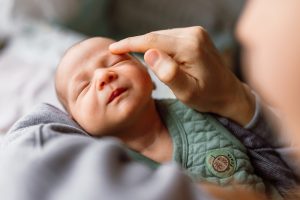
The bacteria that colonize a baby’s gut in the first weeks of life may influence that infant’s risk of developing allergies later on.
Researchers are starting to identify which microbes appear to support healthy immune development – and whether giving newborns certain bacteria could help prevent allergic disease.
At the 2026 ACAAI annual allergists’ meeting, top experts discussed the latest research on the infant microbiome. This included:
• A clinical trial of a bacteria-based treatment in newborns at high risk for allergic diseases. Results showed promising reductions in eczema and food allergy among babies who completed one year of treatment.
• Research on Mennonite infants raised on farms, who have unusually low rates of allergic disease. A beneficial type of gut bacteria may help explain why.
• What parents can do today to support a healthy infant microbiome.
“I think what makes us most excited about the field of human microbiome research is the fact that the microbiome is more medically accessible and more manipulable than the human genome,” says Susan Lynch, PhD. “We’re beginning to understand what shapes microbiomes and how we might manipulate them to promote human health.”
Lynch is the director of the Benioff Center for Microbiome Medicine at the University of California, San Francisco.
Testing Bacteria Combo in Newborns
In the weeks and months after babies are born, they aren’t just learning to recognize mom and dad. Their developing immune systems are learning about the environment around them. Babies’ guts become colonized with an array of bacteria, called the microbiome.
These microbes perform all sorts of important functions, says Lynch. They help to train the immune system, protect from pathogens, and generate substances that can reduce inflammation. Studies have linked an imbalance in the developing gut microbiome to four allergic diseases, including food allergy, asthma, eczema and rhinitis.
Could changing a baby’s microbiome with a “live microbial therapeutic” help prevent allergies? Preliminary results from a Phase 2 trial suggest it’s possible.
The treatment, STMC-103H, was developed by Siolta Therapeutics, a company Lynch co-founded with Nikole Kimes, PhD. Their therapy contains a cocktail of specific bacteria, originally isolated from the stool of babies without allergies.
However, STMC-103H is not derived from donor stool like fecal transplants. Instead, each identified strain is grown separately in fermentation tanks. Siolta says rigorous quality control is used for the organisms, which are then combined to create STMC-103H as a freeze-dried powder. Lynch says the strains are selected for roles in restoring gut function, strengthening the intestinal barrier, and preventing harmful microbes from taking hold.
The Phase 2 trial enrolled 238 newborns, 14 days old or younger at 30 clinical sites. The babies had to have a family history of allergic disease, putting them at high risk for an allergic condition. Infants took either STMC-103H or a placebo daily in their first year of life. Parents mixed the treatment powder with breast milk or formula, giving it through a dropper.
When the researchers looked at infants on the treatment for a full year, they found significant disease reduction. About 23 percent of the at-risk babies taking STMC-103H developed eczema, compared with 43 percent who consumed a placebo.
The Babies, One Year Later
Treatment duration appears to matter. Infants who received more than three months of the bacteria cocktail had a significant reduction, while six months had even greater reductions.
Researchers followed the children for another year after treatment ended to see if the effects persisted.
At 2 years of age, 40.5 percent of at-risk babies who completed a full year of the microbial treatment had developed an allergic disease. That compared to 57 percent given the placebo.
Also by 2 years, 35 percent of children in the treatment group had developed eczema, compared with 53 percent in the placebo group. Food allergy was diagnosed in 6 percent of the treatment group and 16 percent of the placebo group.
There was also a trend toward less asthma and fewer wheezing episodes, although the differences weren’t statistically significant.
“There is a durable impact of daily, early life supplementation with a microbiome-directed therapy in these children,” Lynch says. Among infants who completed one-year of treatment, “we have significant reductions in atopic dermatitis, food allergy and we are trending for asthma.”
Researchers saw no significant differences in adverse events between babies who received the treatment versus the placebo. “These are microbes that should be in the neonatal gut microbiome,” Lynch says.
Siolta is now developing a larger, Phase 3 trial.
Good Gut Bacteria Found in Mennonites

Studies of the “farm effect” have shown that children living on traditional farms are much less likely to develop allergies and asthma than urban kids. Researchers theorize that proximity to farm animals, diverse microbes, breastfeeding and more make a big difference in training the immune system not to react to allergens.
In 2017, Kirsi Järvinen-Seppo, MD, PhD, and colleagues at the University of Rochester, launched a long-running study. Järvinen-Seppo, chief of pediatric allergy and immunology at UR, told the ACAAI meeting that they followed mother-infant pairs from an Old Order Mennonite farming community in western New York and from nearby Rochester. Infants from the city had to have at least one first-degree relative with an allergic condition.
Among the 157 mother-infant pairs who completed the first year of follow-up, just 5 percent of Mennonite infants developed eczema. That compared with 30 percent of Rochester infants who had eczema. None of the Mennonite infants were diagnosed with food allergies, compared to 15 percent of the Rochester infants.
Further research identified several possible explanations. A 2025 study from the UR team found the immune systems of Mennonite babies may mature faster than those of urban infants. Their mother’s breast milk had high levels of protective antibodies, which they may have passed on to their newborns.
When looking at the infants’ gut microbiomes, one bacterium stood out: a type of Bifidobacterium called B. infantis. Mennonite babies had high levels of these bacteria by about six weeks of age. In Rochester, about one-third of infants had no detectable Bifidobacterium at six weeks, while another 52 percent had depleted levels.
‘Vanishing’ Keystone Bacteria
Other studies also suggest Bifidiobacterium is disappearing from infants living in industrialized nations across the globe.
A 2025 U.S. study found just 8 percent of infants under three months old had detectable B. infantis. Meanwhile, 24 percent had no detectable Bifidobacterium at all. The data came from the My Baby Biome study, a national study of the infant microbiome.
“It’s a vanishing keystone bacteria,” says Dr. Stuart Turvey, pediatric immunologist and scientist at the B.C. Children’s Hospital Research Institute in Vancouver.

Why might B. infantis matter? The bacterium helps to digest human milk sugars, says Järvinen-Seppo. As it metabolizes these sugars, B. infantis produces compounds called metabolites that may help maintain the intestinal barrier and regulate immune responses.
But why would urban infants be losing bacteria? Researchers think it has to do with a variety of factors. C-section deliveries, formula feeding, and exposure to antibiotics early in life could play a role, says Järvinen-Seppo.
Young children are also an important source of B. infantis. They pass it to each other, she says. Mennonites tend to have large families. Smaller family sizes may mean less opportunities to acquire it.
The allergy researcher notes that several clinical trials are testing B. infantis as a probiotic in infants at-risk of developing allergies.
Baby Microbiome: What to Do Now?
Turvey offered advice at the allergists’ meeting on how to support a baby’s microbiome development today. Short of relocating to a farm, that is.
A longtime allergies and the microbiome researcher, he recommends doctors avoid prescribing unnecessary antibiotics during a child’s first year. Antibiotic use in the first year has been linked to developing wheezing and asthma by 5 years of age.
Breast milk has been shown to help counter the negative effects of antibiotics. New mothers should be supported in breastfeeding, Turvey says. And “we can encourage children to engage with the broad environment,” he says. That increases their microbial exposures.
“The microbiome is malleable. We can do things about it. We can’t change our genome, but we can change the microbes,” Turvey says. “And changing the microbes potentially allows us to change allergy risk.”
Related Reading:
Gut Microbiome Flaws Linked to Allergies from Food to Eczema
ACAAI 2026: EoE Diagnoses Have Soared Sevenfold
Allergic Mom: How I Introduced My Baby to My Food Allergens