
The U.S. Food and Drug Administration is taking steps to improve label transparency for packaged foods that contain gluten ingredients. The federal agency wants to hear from the public about their reaction experiences with cross-contact from gluten-containing grains, as well as labeling issues.
Consumers with medical conditions such as celiac disease or allergies are advised to avoid gluten-containing grains, including barley, rye or oats (due to cross-contact). But under the current FDA-enforced rules, they face roadblocks doing that.
These grains are not required to be disclosed on ingredient labels in the United States. However, wheat, the most obvious gluten grain, must be included on packaged food labels because it is among the top nine food allergens.
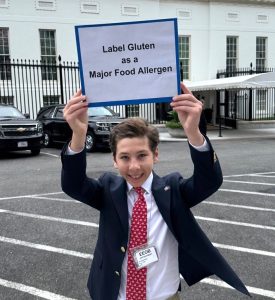
“Eating without fear is our goal,” Jax Bari, who has celiac disease tells Allergic Living. The 12-year-old has long advocated for all gluten, including barley, rye and oats, to be declared on U.S. labels as a major food allergen. The FDA’s move “is a really big step. It’s super exciting,” he says.
The FDA issued a Request for Information on January 21, 2026, to gain a better understanding about how a lack of transparency about gluten-containing ingredients affects consumers. The information will inform next steps, helping the agency decide what regulatory action is needed, the agency’s news release says.
“We encourage all stakeholders to share their experiences and data,” FDA Commissioner Dr. Marty Makary says. “People with celiac disease or gluten sensitives have had to tiptoe around food, and are often forced to guess about their food options.”
The agency credits the citizen petition that Jax and his family created for its move to seek more information about gluten labeling and cross-contact. The seventh-grader and his family filed the petition with the FDA in September 2023.
Comments on Gluten Rules Needed
The Baris’ petition proposes that a requirement for gluten-containing grains labeling alter the existing federal Food, Drug, and Cosmetic Act (FALCPA) labeling law. The FDA process will no doubt consider that, but this will depend in part on the need expressed from the celiac and allergy community.
Jax’s dad, Jon Bari, is thrilled the FDA is moving to address gluten labeling. “We’ve been living with this gluten guessing game that is complex, and unnecessarily so,” he says. “We just want to know whether gluten is in a product.”
An FDA spokesperson told Allergic Living: “The issuance of the request for information is a critical element of how FDA is working to address food allergies as part of MAHA agenda. Specifically, the Make Our Children Healthy Again Strategy Report states, in part, that FDA will make recommendations about requiring transparency in disclosures of ingredients that impact certain health conditions, such as gluten for those with Celiac disease, and other established food allergens.”
The FDA’s request for information is asking for public input on adverse reactions to rye, barley or oats in packaged foods. The agency is also seeking comment on how often non-wheat gluten-containing grains appear in products, but are not disclosed, along with adverse experiences when labeling is unclear.
How to comment:
- Electronically: Comments can be submitted through this government link or, following the initial time period, by searching the rulemaking portal for Docket No FDA-2023-P-3942. (Open for 60 days).
- By mail: Send written comments to Dockets Management Staff (HFA-305), Food and Drug Administration, 5630 Fishers Lane, Rm. 1061, Rockville, MD 20852.
All comments must include: Docket No. FDA-2023-P-3942 for “Labeling and Preventing Cross-Contact of Gluten for Packaged Foods; Request for Information”.
Voices of Gluten Label Change
Betsy Craig, chair of the allergy committee of the Make America Healthy Again Coalition, views the FDA’s action to improve transparency about gluten ingredients is as a key step forward. Craig is the founder and CEO of MenuTrinfo, a leading company in allergy certification and training.
“This creates an important opportunity for the food industry to move toward substantiated, defensible claims supported by documented controls and third-party verification,” she says.
Jon Bari is hopeful that the FDA’s move will eventually result in rulemaking on gluten labeling. For families like his, “that’s a total game changer.”
Bari notes of his son, “here’s a child who is now influencing food and health policy for the United States.” Jax, along with his older sister Lexi, dad and mom Leslie, share their advocacy efforts through the website Celiac Journey. Jax was diagnosed with celiac disease in 2018, at the age of 5.
In August 2025, Jax met with key leaders of the MAHA Commission. He shared his solution for improving the lives of 3.3 million Americans, including 729,000 kids like Jax, with celiac disease.
“I’m so proud of Jax for being willing to share with courage what it’s like to live with celiac disease and not knowing what’s safe to eat,” Bari says. “It’s pretty amazing that they’re listening.”
Related Reading:
‘What Am I Doing Wrong’: Why Celiac Symptoms Persist
Boy Lobbies to Label All Gluten, Not Just Wheat
FDA on Top Allergen Labels: Coconut Off List, Milk Sources Expand