
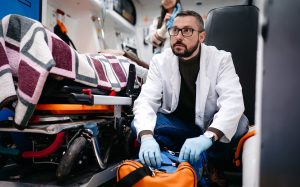
Two physicians recently saved the life of an Etihad Airways crew member who suffered an anaphylactic reaction on a flight. His oxygen levels reportedly dropped to 80 percent – a medical emergency.
In its write-up on the incident, the Medbound Times captures the urgent moments on board the United Arab Emirates-based airline’s aircraft. The flight attendant had collapsed mid-flight and two doctors from India quickly stepped forward to assist. The article describes them working hard to stabilize the patient in a narrow aisle and using the plane’s limited medical equipment.
What struck me most about the report was not what it included, but what it left out: easy-to-use epinephrine. Despite clear medical consensus that epinephrine is the first-line treatment for anaphylaxis, the man’s reported treatment involved oxygen, asthma bronchodilators, antihistamines, and steroids. While these are supportive measures, they do not reverse anaphylaxis.
The patient survived for two reasons. The two skilled doctors happened to be on board. And he had the good fortune that his reaction subsided without epinephrine. Neither will always be the case.
Allergic reactions occur on airlines across the globe, and every untreated anaphylactic reaction is potentially fatal. In these emergencies, the difference between survival and tragedy is often whether epinephrine is given immediately.
Yet today, just a few airlines carry auto-injectors. Many carry only vials for syringe injection, and some still carry no epinephrine for anaphylaxis at all. This lack of standardization puts passengers, health professionals, and flight crews in impossible positions.
Airlines: Epi vs. Narcan
In the United States, the 2024 Federal Aviation Authority Reauthorization Act mandated a review and update of airline emergency medical kits. The intent is to ensure they are equipped to handle medical emergencies, specifically including anaphylaxis.
As a leading advocate for safe airline travel for people with food allergies, I view this as a significant step toward making epinephrine available in user-friendly forms such as auto-injectors or nasal sprays.
I also hope that explicitly mentioning anaphylaxis in the FAA reauthorization will shift the regulatory landscape from a voluntary approach to a standardized and enforced requirement for airlines to carry easy-to-use epinephrine. The FAA has until May 2026 to issue a final rule updating emergency medical kit requirements.
Another drug the FAA wants included in the airline medical kits by that time is Narcan (naloxone). However, several U.S. airlines did not wait for regulation to add Narcan to emergency medical kits (EMKs) – they acted to include it following a tragedy. In 2019, a man reportedly died from an opioid overdose on a Delta Air Lines flight when naloxone was not available. That death, combined with the broader opioid crisis on the ground, helped to mobilize flight attendants and lawmakers to push for change.
U.S. Representative Brittany Pettersen, who sponsored legislation related to naloxone access, said: “One thing we can do to save lives during this opioid crisis is ensure that naloxone, or similar overdose-reversal drugs, are available in as many places as possible, which should include commercial aircraft.”
The Association of Flight Attendants president Sara Nelson emphasized that onboard crews are aviation’s first responders and must have the tools to save lives. She praised the FAA for indicating that naloxone would be added as a required drug in the EMK in the Reauthorization Act’s update.
Airlines Slow on Epi Devices
I have no criticism of carrying naloxone in the plane’s EMK. It saves lives and belongs there. But the contrast with epinephrine devices is baffling. There are no reliable statistics on the frequency of opioid overdoses in flight, yet airlines moved decisively on naloxone.
Meanwhile, we do have data on food-allergic reactions in the air. Northwestern University’s Center for Food Allergy & Asthma Research conducted a global study of 4,700 travelers managing food allergies. It revealed that 8.5 percent reported experiencing an allergic reaction while flying, most commonly to peanuts and tree nuts.
When Allergic Living created our comprehensive Airlines & Allergies Guide, we confirmed what medications individual airlines stock to treat allergic reactions. We asked what form those medications are carried in, and whether crew members receive training related to anaphylaxis. As we worked on the Airlines Guide, the FAA reauthorization passed. So I asked two major U.S. carriers, Delta and United, whether they would also voluntarily add easy-to-use epinephrine devices. Both said no. Yet, both had voluntarily added naloxone to their kits.
As with an overdose, food allergies carry a life-threatening risk and a time-critical need for treatment. As food allergies continue to rise worldwide, the logic that is leading airlines to voluntarily stock naloxone in the air applies equally to easy-to-use epinephrine for anaphylaxis.
This decision matters. Cabin crews in the United States are not trained to draw epinephrine from vials, the only form of the drug currently required. Volunteer medical professionals also deserve access to best-practice medications in the emergency medical kits they are asked to use.
Passengers experiencing anaphylaxis may not be able to self-administer their own auto-injector or may need additional doses. Research consistently shows that delays in epinephrine administration increase the risk of poor outcomes.
To Know Before You Fly
Awareness is critical. If you live with food allergies, or are a physician, nurse, or paramedic who could be called upon to respond in the air, you need to know what is – and is not – on board before an emergency happens.
We strongly urge consulting Allergic Living’s Airlines & Allergies Guide before you fly. This resource offers U.S., Canadian, and international airline comparisons, details what allergy training is provided, which medications are carried, and much more. This is not just consumer information, it is clinical risk management at 35,000 feet.
Air safety regulation has a long history of changing only after preventable harm becomes undeniable. The pattern is familiar: evidence accumulates, near-misses multiply, advocacy intensifies, and regulators ultimately move from voluntary guidance to mandatory standards. We are at that inflection point with epinephrine in airline emergency medical kits. Narcan’s rapid adoption shows that airlines can act quickly when they choose to.
What remains unanswered is why the same urgency is not being applied to anaphylaxis – a condition with a clear first-line treatment, clear time sensitivity, and clear fatal risk. We should not need a death at cruising altitude to finally achieve this lifesaving change.
Nor should we have to count on being one of the lucky ones, like the Etihad Airways crew member.
Lianne Mandelbaum is Allergic Living’s airlines correspondent, and the founder of NoNutTraveler.com.
Related Reading:
It’s Come to This: ‘Borrowing’ Epinephrine on Planes
Anaphylaxis Over Ocean: MD Finds No Epinephrine Vial in Plane’s Kit
Allergic Living’s Airlines & Allergies Guide: Domestic
New FAA Act Will Make Airplane Medical Kits Anaphylaxis Ready