

At a Nov. 17 conference, Robert F. Kennedy Jr. expressed determination to study aluminum adjuvants as a potential root cause of the food allergy epidemic. He stressed the need for such a study, despite acknowledging there is no current scientific data to back such a connection.
The Health and Human Services Secretary was then supported on the concept of this study by the director and acting director of the National Institutes Health (NIH) and the National Institute for Allergy and Infectious Diseases (NIAID).
“As the secretary said, this would require clinical trials,” Dr. Jeffery Taubenberger of NIAID told the nonprofit Food Allergy Fund’s leadership forum in D.C. “Prospective clinical trials, well-designed, and they would have to be long term. It would be expensive but these are the things that should be discussed,” said Taubenberger. NIH director Dr. Jay Bhattacharya, speaking alongside him, agreed: “Those are the things that have to be discussed.”
Illinois allergist Dr. Zachary Rubin expressed concerns to Allergic Living about Kennedy’s focus on spending limited federal funds to research aluminum adjuvants and the onset of food allergies.
The allergist and social media commentator stressed the weight of scientific evidence against such a link. This includes the findings of a major Danish study. “It looked at the cumulative exposure of aluminum during the first few years of life and didn’t see a significant increase in the amount of allergic or autoimmune diseases,” says Rubin.
The amount of aluminum in vaccines is minuscule and used to boost the immune response to a vaccine. The CDC asserts that it’s not readily absorbed in the body.
“This is RFK Jr. as Health and Human Services (HHS) secretary saying these things not based in science,” says Rubin. “When you have someone as influential as that stating such things, it’s going to scare and confuse a lot of new parents. It will potentially give rise to more vaccine hesitancy.”
Kennedy Disputes LEAP Findings
Rubin, author of the forthcoming book All About Allergies, raises that vaccines against diphtheria, tetanus and whooping cough, which also contained aluminum, began being used in the 1930s and ’40s. He says that if aluminum was a food allergy cause, “we would have seen an explosion of allergies and anaphylaxis at that point.”
In his discussion with FAF executive director Ilana Golant at the forum, Kennedy stressed his experience as a father of seven kids, five of whom have allergies. One son experienced numerous trips to the ER for food anaphylaxis as a toddler.
Kennedy then made controversial remarks related to introducing allergenic foods to infants, particularly peanut, to prevent food allergies. NIAID helped to fund the groundbreaking 2015 LEAP study. It found that early peanut introduction in high-risk infants reduced peanut allergies by more than 80 percent. In October, a study published in the journal Pediatrics credited early feeding guidelines, based on LEAP, for a phenomenal 43 percent drop in the rate of peanut allergy in America.
Yet, as allergists were still hailing that success, Kennedy told the FAF forum that “to me, that’s not a convincing hypothesis.” The secretary’s reasoning included the anecdotal. His wife during pregnancy, his kids and he had eaten peanut butter all the time. And yet his children’s allergies emerged.
Then he also suggested a timeline for the peanut allergy epidemic, tracing its start to around 1989. “So you have to look at an environmental toxin that became ubiquitous during that year across all the different demographics.” He says “such studies have never been done. We are going to do them now.” He suggests it could be aluminum adjuvants or possibly pesticides. “Those kind of things that we have to look at.”
LEAP Evidence, Allergy’s Root Causes
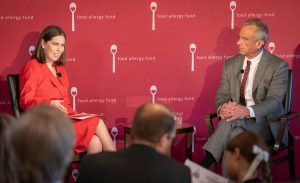
FDA commissioner Dr. Marty Makary and Taubenberger each told the audience that the LEAP-related guidelines are an example of effective food allergy prevention. Yet, Kennedy parted company with his experts. “It doesn’t make any sense to me is that peanut allergy is just a form of deprivation of peanuts. There are many countries in the world that only started eating peanuts recently, and you didn’t see huge waves of peanut allergy.”
Allergic Living reached out to Dr. Gideon Lack, co-author of the LEAP study and a professor of pediatric allergy at King’s College London, for his thoughts. Lack declined to comment directly on Kennedy’s doubts about early food introduction.
“What I will say, is that I stand by my findings on the prevention of peanut allergy,” Lack said. “The LEAP findings show that early introduction of peanuts in young babies in the first year of life significantly protects against developing peanut allergy and essentially eliminates over 80 percent of peanut allergies.”
Lack adds that the LEAP study’s conclusions have since been supported by two large population studies – the EAT study and a Scandinavian study. These two studies again showed a significant reduction in peanut allergy in infants with early food introduction.
“So the efficacy is clear,” says Lack. He also notes the evidence of the effectiveness of newer infant feeding guidelines in the October Pediatrics study. He says its finding of a 43 percent drop in peanut allergies from pre-2015 to 2020 “represents a huge number of cases of peanut allergy being prevented.”
Finding Root Allergy Causes
In his talk, Kennedy also raised concern about the rise in chronic inflammatory conditions in children. Lack agrees with that – and with Kennedy’s expressed commitment to get to the underlying causes of food allergies.
Lack notes that since the end of the Second World War, there’s been a tripling or quadrupling of rates of infant eczema. “The common denominator, we believe, is the chronic inflammatory disease driving peanut, other food allergies and other allergies. The health secretary is right, we do need to find the root causes.”
In fact, Lack is a leader in the NIAID-funded clinical trial called SEAL that is investigating the skin barrier and eczema prevention. “We need to find out what in the environment – from detergents, enzymes, soaps and excessive cleansing to a sparse microbiome,” says Lack. “What may be causing eczema and other inflammatory conditions and dysregulation of the immune system.”
“So eating peanuts has an important role,” he continues, “but there’s something that’s changed in the environment that leads to a susceptibility to food allergies. We know how to prevent it, but we need to find the root causes.” (Lack did not, however, point to investigating vaccine adjuvants.)
Food Allergy Theories

Rubin also supports looking at root causes of food allergy beyond early food introduction in babies. He stresses, however, that there’s no scientific justification for including aluminum adjuvants in vaccines in that effort.
Research has suggested for a few years that the reasons behind the rise of food allergies and other allergies are likely multi-factoral. Rubin notes that theories include the types of bacteria in the gut microbiome, C-section births, infant exposures to antibiotics, vitamin D deficiency, pesticides and more.
“To an extent, I do give RFK Jr. credit for saying, ‘don’t put all your eggs in one basket,'” says Rubin. But when FAF’s Golant then suggested that “multiple factors” were involved in food allergy’s dramatic rise, the allergist notes that Kennedy changed course. He appeared to return to his aluminum adjuvant bias.
“There may be many factors. There may be only one,” Kennedy told Golant. “We don’t know.” Rubin says: “It’s confusing when you listen to him. He’s changing course within the same interview.”
Kennedy often raises concerns about aluminum, usually in the context of autism’s rise. In October, the New York Times reported that U.S. federal health officials are already studying whether to remove aluminum salts from vaccines. Vaccine experts are alarmed, noting this could impact half the U.S. supply of childhood vaccines, including the DTaP vaccine that protects against diphtheria, whooping cough, tetanus and polio.
At the forum, the Food Allergy Fund announced its own allergy initiative – the Microbiome Research Collective. It has significant private funding to investigate how the gut microbiome influences allergic diseases. The collective’s aim is to develop microbiome-related food allergy treatments.
Related Reading:
Early Peanut Introduction Linked to Drop in Rate of Food Allergies
Inside the Microbiome: Good Bacteria as the Big Hope for Allergic Disease