
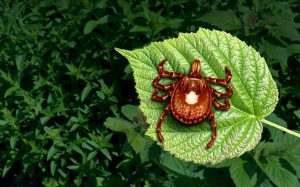
Researchers are confirming alpha-gal syndrome as the cause of death in a 47-year-old New Jersey father. His is the first-known, consumption-related fatality from the syndrome, often called red meat allergy and triggered by the bite of a lone star tick.
The man, a pilot, was unaware that he had alpha-gal syndrome or AGS. He died of anaphylaxis four hours after eating a hamburger at a barbecue, according to medical researchers at the University of Virginia.
It’s important to know that the delay in an AGS reaction does not predict its severity, says UVA Health’s Dr. Thomas Platts-Mills, who discovered alpha-gal syndrome. “Even if you’re looking at a fatal event, there’s still four hours of nothing. That is extraordinary,” world-renowned allergist Platts-Mills tells Allergic Living.
The New Jersey man’s wife, seeking answers to his sudden, unexplained death in September 2024, asked the researchers to investigate the cause. Their findings are published in the Journal of Allergy and Clinical Immunology: In Practice.
After eating a burger and drinking a beer at the barbecue, the man went home and mowed the lawn. He started to feel ill that evening, and his son checked on him around 7:30 p.m. The report says he found his dad unconscious on the bathroom floor, surrounded by vomit.
In AGS, the bite of a lone star tick triggers reactivity to alpha-gal, a sugar present in mammals’ meat and byproducts like dairy and gelatin. The symptoms frequently come hours after eating. This makes it difficult to connect escalating symptoms to a food as the culprit.
Alpha-Gal Finding After Death

In fact, the New Jersey man had a severe reaction to steak on a family camping trip just two weeks before his death. He woke up in the middle of the night, experiencing severe diarrhea, vomiting and stomach pain. These are all symptoms of an alpha-gal reaction, but he had no idea the red meat was to blame.
“I’ve heard patients describe symptoms that sound very similar to what this patient was experiencing before he went into shock,” allergist Dr. Erin McGintee tells Allergic Living.
“That’s what a severe alpha-gal reaction looks like,” she says. McGintee has more than 1,100 alpha-gal cases at her practice in Southampton on Long Island, New York, where the lone star population has surged.
Platts-Mills investigated the man’s death after learning about him from Dr. Erin McFeely, a New Jersey pediatrician and co-author of the paper. McFeely and the pilot had daughters in the same ballet class.
The investigation centered on blood samples that were collected and tested post-mortem. Those tests revealed the alpha-gal sensitivity. The investigation also confirmed a very high level of tryptase in the man’s blood serum. The research found this consistent with fatal anaphylaxis.
While this is the first documented alpha-gal death related to eating red meat, there is at least one earlier alpha-gal death attributed to the cancer drug cetuximab. That drug contains the alpha-gal sugar molecule and can trigger anaphylaxis in those with AGS.
New Jersey Tragedy: Clues in the Blood

Platts-Mills spoke to the New Jersey man’s wife about the case, and tested the blood samples. The tests revealed positive IgE levels for allergens, including alpha-gal, beef and ragweed. The level of IgE to alpha-gal found in his blood was 3.4 percent of his total IgE, the report states. It notes that values over 1 percent are relevant.
A tick bite can trigger the immune system to begin producing IgE allergy antibodies to the alpha-gal sugar found in red meat (from beef to pork, venison and lamb). For many, even dairy and gelatin set off reactions.
Based on the IgE levels in the blood tests alone, McGintee is surprised that this was the patient who suffered fatal anaphylaxis.
Given the severity of the man’s reaction, She expected the IgE ratio to be higher. Her patients who have had more severe reactions have had ratios that are closer to 10 or 20 percent of the IgE. However, she notes, “Unless your alpha-gal IgE is undetectable, there’s no guarantee that you won’t react.”
The allergist agrees with the researchers that other variables could have contributed to his fatal reaction. They include, “drinking a beer with the hamburger, exposure to ragweed pollen, and exercise that afternoon, which ended 1 hour before the start of symptoms,” the report states.
Surging Tick Population
During the UVA researchers’ investigation, they asked the man’s wife if she recalled him being bitten by a tick. She only remembered him having about a dozen chigger bites around his ankles earlier that summer.
Chiggers, common in the eastern United States, are often the larvae of lone star ticks. The tiny chiggers can also bite humans and can cause sensitization to alpha-gal, the report states.

But many people see chiggers as little black dots that you hardly notice, unless it is causing itching, Platts-Mills says. “Itching is an important part of the response,” he says.
“People who live in areas endemic for the lone star tick should know that this exists,” McGintee says. “If they’ve had bites that they’re concerned about they should schedule a consultation with an allergist to discuss next steps.”
McGintee who is familiar with chigger bites on a personal and clinical level, says multiple chigger bites at once can be more dangerous than one tick bite. Several chigger bites can have a greater impact on the alpha-gal IgE in a patient who makes the alpha-gal antibody.
More people are at risk of developing alpha-gal syndrome as the population of deer, the main hosts of the lone star tick, increase and the lone star tick moves north, the report states. In fact Platts-Mills says tick mothers lay about 5,000 eggs at a time.
The report states that many sensitized individuals “are unaware of the fact that both larvae (‘chiggers’) and mature ticks can cause sensitization to alpha-gal.”
Raising AGS Awareness
Awareness about the alpha-gal allergy and its symptoms is essential. McGintee notes that is important for people to remember that, while this man’s alpha-gal death is tragic, it is rare.
People can develop this allergy after lone star tick bites, but people can also have a positive alpha-gal test after a bite and not be allergic to meat. The diagnosis comes from more than a test, McGintee says. For example, knowing which foods could be triggering a patient’s symptoms, along with the history of tick bites, are factored into determining a diagnosis.
Patients who have been diagnosed with alpha-gal syndrome are advised to keep epinephrine on hand, be mindful of any tick bites and know their own clinical history.
The researchers note that awareness is needed about AGS and about how symptoms present, such as stomach cramping hours later. “We would argue that there is a major need for public education in areas where the tick is increasing,” the researchers note.
Candice Matthis and Debbie Nichols, who founded Two Alpha Gals and the Alpha-Gal Foundation, agree. “This tragedy emphasizes the critical need for awareness to help prevent similar devastating losses in the future,” they told Allergic Living.
The two Virginia woman, whose website provides guidance and support for other people living with alpha-gal syndrome, know the fatality is concerning for their community.
“We encourage our community to advocate for their health and to seek support from family, friends, or the broader alpha-gal community,” they said.
Related Reading:
Dr. Commins on Alpha-Gal Allergy: Dairy to Testing and Meat Fumes
20-Year-Old Dies of Peanut Allergy – That He Didn’t Know He Had
Alpha-Gal Allergy Signs and Steps to Avoid Ticks