
In parts of Europe, Asia and Latin America, doctors may prescribe an unusual treatment to ward off colds and other respiratory illnesses: bacteria capsules.
The capsules, called OM-85, contain fragments of 21 strains of common respiratory bacteria. Taken before cold and flu season, these dead bacteria appear to prime the innate immune system. That’s the body’s first line of defense against foreign invaders. This helps the immune system to respond faster when live germs show up.
OM-85 isn’t yet available in the United States. But its Swiss maker, OM Pharma, has launched a U.S. clinical trial in the hopes of bringing the drug here. The trial is testing whether the medication can reduce respiratory illnesses and recurring wheezing in children ages 6 months to 5 years.
A second study, this one led Dr. Fernando Martinez at the University of Arizona, is testing whether the capsules might do something even more remarkable: prevent wheezing before it ever starts. The concept is that early exposure to the bacterial fragments may teach the immune system to respond appropriately to triggers of wheezing and airway inflammation. The goal is to keep asthma from developing later on.
The children in the asthma prevention study receive OM-85 bacteria starting when they’re between 6 and 18 months old. They’re then followed until they’re 3 or 4 to see if the capsules prevent wheezing and asthma-like symptoms.
“I’ve been trying to prevent asthma for the last 30 years of my career,” says Martinez, director of the university’s Asthma and Airway Disease Research Center.
“And for the first time, we have a product that we want to test that we believe may prevent the development of these wheezing illnesses that we believe are the gateway toward the development of asthma.”
Revving Up Immunity
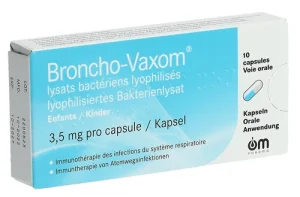
Sold under the brand name Broncho-Vaxom, OM-85 was first approved in Switzerland in 1979. Four decades later, it’s prescribed in over 60 countries to prevent respiratory illnesses.
The brand’s capsules come in adult and pediatric strengths. The typical course is to take them 10 days each month for three months leading up to cold and flu season. “It has a very good safety profile. It’s been used in about 150 million kids and adults,” says Lorenz Lehr, PhD, OM Pharma’s head of clinical and preclinical development.

Broncho-Vaxom is a bacterial lysate, a class of drug made from dead bacteria fragments such as Staphylococcus and Streptococcus. Initially, scientists thought the medication worked like a vaccine, boosting the adaptive immune system’s response to the specific pathogens in the capsule, Lehr says. (Hence, the drug’s name).
But newer research suggests that Broncho-Vaxom stimulates the innate immune system. This is the body’s fast-acting first line of defense against a broad range of pathogens, from bacteria to viruses, Lehr says.
Studies support the broader effect. A review and analysis of randomized controlled trials found that children who took OM-85 had fewer respiratory infections than children given a placebo. They also used antibiotics less often, had fewer fevers, cough and wheezing episodes.
In a Turkish study, 75 preschoolers with wheezing triggered by infections had 38 percent fewer attacks after OM-85 treatment than those given a placebo. When they did wheeze, the episodes lasted two days shorter on average.
Other studies have found that OM-85 may reduce levels of immune system signaling molecules called cytokines associated with inflammation.
Could Bacteria Capsules Prevent Asthma?
Findings like these caught the attention of Martinez, a leading asthma researcher. About 5 million U.S. children have asthma, and rates have surged over recent decades. Wheezing tends to start in the first three years of life. Airway remodeling, or permanent structural changes, can follow.
One theory for asthma’s rise points to reduced exposures to protective microbes at key stages of immune system development. Studies of the so-called “farm effect” have shown that children raised on farms are much less likely to develop allergies and asthma than urban or suburban kids.
Scientists believe early, repeated exposure to a wide variety of microbes through contact with livestock and farm dust helps train developing immune system to tolerate harmless substances, like pollen or food proteins, without overreacting, as in asthma and allergies.
Our relatively more hygienic lives protect us from dangerous microbes that cause terrible diseases like cholera and typhoid fever. But there may be a downside to modern-day cleanliness.
“We try not to expose children to pathogenic bacteria with good reason,” Martinez says. “But once we stopped exposing to children the pathogenic bacteria, we also stopped exposing them to the protective bacteria, and we created a problem.”
Other research suggests the repeated use of antibiotics in early childhood may further set the stage for asthma and allergies.
Which Bacteria Protect?
Attempts to identify specific species of protective bacteria have fallen short, Martinez says. Studies on probiotics such as Lactobacillus have shown only modest or mixed effects on asthma.
“There are trillions of bacteria and species we don’t even know,” Martinez says. “It’s not just the bacteria. What really matters to the immune system is the metabolites they produce.” Metabolites are the products of bacterial digestion and energy production.
Because OM-85 exposes the immune system to a mix of microbes and their metabolites, Martinez wondered if it could simulate the protective “farm effect.”
His NIH-funded ORBEX trial began enrolling kids ages 6 to 18 months at 11 sites nearly a decade ago. The study was delayed during the pandemic, when the closure of daycare and schools reduced exposure to common bugs and fewer kids were getting sick.
All told, the trial has enrolled 800 children at high risk of developing asthma because of eczema, or they have a parent or older sibling with asthma.
One group of children consumed a powder containing the OM-85 extract, mixed into juice or yogurt, for 10 days each month. They took this for two years, while the other group received a placebo. The children were then followed for three more years. Families received weekly text messages asking them report illnesses or wheezing episodes.
With the final group of study participants wrapping up by the end of 2025, “after 10 years of waiting, we’re going to know the results,” Martinez says.
Bacteria Capsules: Reducing Wheeze
Meanwhile, OM Pharma is also running new clinical trials in Europe, China and the United States. While Martinez’s study focuses on asthma prevention, the company’s trials focus on how well the capsule reduces respiratory illnesses and wheezing in children who already show symptoms.
In Europe, the BEAR trial is a six-country study testing OM-85 in children ages 6 months to 5 years with recurrent wheezing. Participants take either a full year of OM-85, OM-85 for three months followed by nine months of placebo, or placebo alone. Results are expected in 2027. Results from another trial in China in children ages 6 to 12 with asthma are expected in 2026.
In the U.S., the company’s Phase 2b clinical trial involves children ages 6 months to 5 years with recurrent wheezing. Called EAGLE, participants will either take OM-85 daily for six months or a placebo. Results are expected in 2027.
In the ORBEX study, some parents already suspect their children are taking OM-85 because they rarely get sick. “One family said, ‘We have four children, and this is the only one that doesn’t have asthma,’” Martinez says. But the trial is double-blinded, so neither families nor researchers know who received the bacteria and who got the placebo.
If his trial succeeds, Martinez says OM-85 could become the first medication to prevent asthma rather than simply manage it. “I want these kids not to have asthma when they stop taking it, and not to have it for the rest of their lives,” he says.
“If we can prevent asthma, can you imagine? It’s very, very exciting for many people.”
Related Reading:
Gut Microbiome Flaws Linked to Allergies from Food to Eczema
Scientists Elated as Asthma Drug Stops Food Anaphylaxis in Mice
Asthma Medications Guide: What to Know for Optimal Control