

While swimming in her neighborhood pool, Stacey Vigil, a wildlife biologist, felt a sharp sting on her back. She swatted behind her, expecting a bee. Instead, she found an ant.
It was small, but its sting was potent. It left her with a painful, 3-inch welt that itched for a month.
The second time was worse. That next summer, while sitting on the pool’s edge, two sharp jabs pierced the back of her thigh. “It hurt a lot. It was a really deep, pulsing pain,” says the 44-year-old Atlanta resident.
“The palms of my hands started to itch. My ears started to itch. Then my scalp. My face, tongue and mouth swelled up. I started getting panicky.”
She was having an anaphylactic reaction.
Urgent care staff treated her with antihistamines, steroids and asthma medications. She recovered, though her doctor later said they should have immediately administered epinephrine, the only medication that halts anaphylaxis.
Back at home, her scientist’s curiosity kicked in. What was that little beast? She returned to the scene of the sting to collect a specimen. Under a microscope, she identified it: an Asian needle ant.
Asian Needle Ants Tiny, But Potent
Native to East Asia, these invasive visitors were first spotted in the U.S. in Georgia 90 years ago. For decades, they spread “relatively unnoticed” throughout the Southeast, according to the USDA.
Lately, sightings have soared. Colonies have crept into neighborhoods in at least 19 states, from Florida to New York, Indiana, Ohio, and as far west as Washington state.

As they’ve spread, so have concerns about their potential to trigger anaphylaxis. In Japan and South Korea, Asian needle ants are a well-established cause of severe allergic reactions.
A study from a needle ant-infested town in Korea found about 2.1 percent of residents reported “systemic” reactions after a sting. Another 1.6 percent experienced large local reactions, mainly painful, swollen welts.
In the U.S., a 2018 study documented 21 reports of serious allergic reactions to stings over eight years in seven states and Washington, D.C.
“These are a legit medically important pest,” says Daniel Suiter, PhD, an Orkin Distinguished Professor of urban entomology at the University of Georgia Extension.
He suspects reported cases likely represent a fraction of actual cases. “It’s probably the tip of the iceberg,” he says.
Vigil knows of many others in Georgia who have had “big local reactions, with welts that last for weeks and itch.” However, she’s the only one she knows of who has experienced anaphylaxis.
“Everybody around here knows about the really bad stinging ants,” she says.
Ants and Anaphylaxis Risks
Worldwide, there are dozens of stinging ant species. Some, like the fire ant found in the Southeast, Texas and California, or the jack jumper ant of Australia, can cause anaphylaxis. Like honey bees and wasps, allergic reactions to ant stings are caused by hypersensitivity to venom.
Suiter often fields calls from locals seeking help with identifying unknown bugs, dealing with insect infestations in homes and gardens, and increasingly, stinging ants. A woman once drove three hours to his office in Athens from southern Georgia to bring him a dead twig ant. Native to Mexico and resembling a wingless wasp, the ant had stung her husband, a farmer, who nearly died from an anaphylactic reaction.
Over the past several years, Suiter has received about one report a year of severe allergic reactions to Asian needle ant stings. His antennae went up in 2024, when three reports came in.
In one case, a woman was stung by a needle ant on her towel at a backyard pool. She became dizzy, “fell, broke three ribs and her cheek,” Suiter says. At the hospital, doctors “said a few more minutes would have been too late.”
Are Needle Ants Aggressive?
Although they’re not aggressive, Asian needle ants can sting more than once. They can also wipe out native ant colonies. That happened in his own backyard, which borders woodlands. He has so many Asian needle ants living under his flagstone patio that his graduate student used his property for a research project testing insecticides.
Suiter too was stung while picking up a pile of mulch. “The pain ramps up and gets more severe over a 20-minute period. Then it died off, and came back again,” he says. Some report the pain subsiding and then returning hours or even days later.
How To Spot Needle Ants
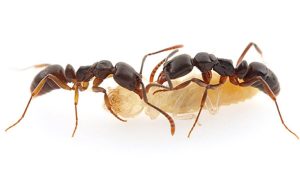
Asian needle ants are brown to black, with lighter legs, and about 3/16th of an inch long. They look a lot like many other ant species, making it difficult to identify them.
Their distinguishing feature is a large stinger at the end of its abdomen. But that’s not visible to the naked eye.

You might find clues in their behavior and where you find them.
Asian needle ants can live in a forest, or in yards or near schools or businesses. They prefer moist, shaded areas. Decaying wood, leaf debris, mulch, or under stones and pavers, are favorite hideouts. They also fall into pools.
Unlike other common ant species, Asian needle ants don’t build mounds. They also don’t form trails. Instead, they forage alone, searching for their preferred meal of termites and other insects.
Asian needle ants don’t tend to wander inside, Suiter says. You might find them around your house, under doormats, on decks, even in the garage. But they probably aren’t too interested in your kitchen because they prefer to eat insects not “human” food.
They’re also not good climbers, so you don’t have to worry about one falling on you from a tree. “You’ll mostly see them on the ground,” Vigil says.
Marching On
Vigil’s physical recovery from anaphylaxis took a few weeks. But the psychological recovery is still in progress. An entomology and ecology researcher, her consulting company conducts field surveillance of diseases such as West Nile virus carried by mosquitos and midges.
She’s traipsed through swamps and deer farms to set bug traps. “I’ve been stung and bitten by plenty of insects,” she says.
But the Asian needle ant reaction was unlike any other. Three years later, she rarely wears shorts and never goes barefoot. She avoids the pool where she was stung and always carries epinephrine auto-injectors.
She also read that yellow jacket and Asian needle ant venom share proteins, raising the specter of cross-reactivity.
Asian needle ants “absolutely are a problem and becoming more of a problem,” she says. “My doctor said if I have any type of a reaction again, use epinephrine and call 911 right away. That’s what I plan to do.”
Sidebar: What You Can Do
Asian needle ants are most active from April to September. Their stings usually occur when people accidentally disturb an Asian needle ant while gardening, reaching into a wood pile, stepping on an ant while barefoot, or swimming in a pool where they’ve fallen.
“They’re not like fire ants. They won’t climb up you and sting you a whole lot of times,” Vigil says. “You are mostly likely to get stung if you sit down on one, or get one in your bathing suit like I did,” she says.
How to Reduce Risks
- Remove fallen logs and leaf litter from your property.
- Be cautious when gardening or handling mulch or stones.
- Wear shoes when outdoors.
Does Ant Bait Work?
Asian needle ants aren’t attracted to sugar-based ant bait you’d use with other ant species, Vigil says. They may respond to protein-based insecticides. (One brand is Advion Fire Ant Bait.)
However, Asian needle ants don’t use pheromone trails to attract other ants to food sources, which means other ants aren’t hurrying to the bait. Vigil has found that while protein-based bait seems to help reduce their numbers, she still has plenty in her yard and has not been able to get rid of them.
Help With Identification
If you’re worried that you have Asian needle ants on your property, you can carefully collect one or two and preserve in rubbing alcohol. (Just don’t get stung while doing this). Then contact your county’s Cooperative Extension office, which can help with identification.
Getting Tested
There is currently no Asian needle ant venom skin testing or immunotherapy available in the U.S., according to AAAAI.
Related Reading:
Stinging Insect Allergies: Ants